
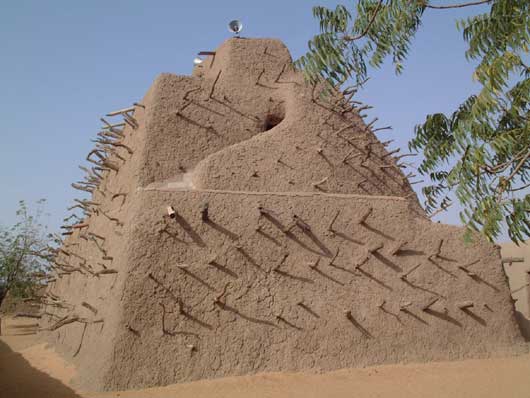
The Songhai Dynasty (Songhai or Songhay) became the largest empire in African history and the most powerful state in West Africa during the Middle Ages. Its rise marked a period of political and cultural flourishing across the Sahel, a period which saw vast developments in trade, intellectual growth, and military expansion. The dynasty evolved from a relatively small kingdom to a regional superpower, dominating the Western Sudan through strategic conquests and alliances.
Early History and Origins of the Songhai
The origins of the Songhai people can be traced to the banks of the Niger River around the city of Gao. By the 8th century, Gao had become a significant trading hub due to its location on the trans-Saharan trade routes. Songhai society initially organised itself into smaller chiefdoms, but its significance grew as it became a vassal state of the larger Ghana Empire in the 10th and 11th centuries, and later under the Mali Empire in the 13th century.
Gao, the capital of Songhai, was an ancient city known for its strategic importance. It had been a key centre for commerce, facilitating the exchange of gold, salt, slaves, and other goods between North Africa and sub-Saharan Africa. The city’s prosperity attracted diverse peoples, creating a cosmopolitan environment that influenced the culture of the Songhai. Though nominally under the control of the Mali Empire during the height of Mali’s power, Songhai rulers maintained a degree of independence, and their aspirations to break away from Mali would eventually materialise.

The Decline of the Mali Empire and the Rise of Songhai
The decline of the Mali Empire in the 14th century opened the door for the Songhai to assert their independence. Mali’s internal struggles, especially disputes over succession, left it vulnerable to regional powers. The Songhai took advantage of Mali’s weakened state. By the mid-15th century, under the leadership of Sunni Ali Ber, Songhai emerged as the dominant power in the region.
Sunni Ali Ber (1464–1492), often considered the true founder of the Songhai Empire, was a powerful and ambitious ruler. He conducted numerous military campaigns to expand his empire’s borders. He successfully conquered the ancient trading cities of Timbuktu in 1468 and Djenné in 1475. Both cities had been centers of wealth and Islamic scholarship under Mali’s control. Sunni Ali’s aggressive expansion allowed Songhai to dominate trade routes, particularly those that dealt in gold, salt, and slaves.

Sunni Ali’s Reign and Military Prowess
Sunni Ali’s reign was defined by his military prowess and unrelenting ambition. He was able to develop a powerful navy that patrolled the Niger River, using it both as a means of transportation and a tool of warfare. His army was equally formidable on land, known for its speed and discipline. Sunni Ali was an astute tactician, employing guerrilla-style warfare and ruthlessly subduing any opposition. This allowed him to secure the loyalty of conquered territories while maintaining control of key trade routes.
However, despite his military successes, Sunni Ali was often viewed as a controversial figure by his contemporaries. His policies were sometimes seen as being in conflict with Islamic teachings, especially among the Muslim scholars of Timbuktu. He was known to have persecuted some Muslim scholars, which led to tension between his administration and certain Islamic factions within the empire.
Askia the Great: A Golden Age of Songhai
Sunni Ali’s death in 1492 triggered a brief power struggle. His son, Sunni Baru, assumed the throne. However, he was deposed within a year. This was due to his inability to unite the empire and his rejection of Islam. Sunni Baru’s fall led to the rise of Muhammad Ture. He is known as Askia Muhammad I or Askia the Great, one of the greatest rulers in West African history.
Askia Muhammad I (r. 1493–1528) was a visionary leader who transformed Songhai into a sophisticated and stable empire. His reign marked the height of Songhai’s cultural, economic, and political power. Unlike Sunni Ali, Askia Muhammad was a devout Muslim and sought to establish Islamic governance in Songhai. He made a celebrated pilgrimage to Mecca in 1497, similar to the famous pilgrimage of Mansa Musa of Mali a century earlier. This journey not only bolstered his legitimacy as a Muslim ruler but also strengthened diplomatic and economic ties between Songhai and the broader Islamic world.

Upon returning from Mecca, Askia Muhammad implemented Sharia law. He built an administrative state that blended Islamic principles with traditional Songhai customs. He restructured the empire’s military, improved tax collection systems, and appointed governors (called fari) to manage different regions of the empire. This bureaucratic system allowed the empire to flourish even as it expanded across a vast and diverse territory. Timbuktu, under Askia’s patronage, became one of the most important intellectual and commercial cities of the Islamic world. It attracted scholars from across North Africa and the Middle East, making Songhai a centre of learning.
Economic and Cultural Achievements
During Askia Muhammad’s reign, Songhai became a trading powerhouse, connecting the Islamic Mediterranean with the gold-producing regions of West Africa. The empire thrived on the trans-Saharan trade, dealing in gold, salt, kola nuts, textiles, and slaves. Trade routes stretched from the heart of Songhai to the coasts of North Africa. They passed through cities like Walata, Timbuktu, and Gao. Songhai’s prosperity also relied on its agricultural output. This was particularly true along the fertile banks of the Niger River. There, crops such as millet, sorghum, and rice were cultivated.
Culturally, the empire was a melting pot of various peoples, including the Songhai, Mandé, Tuareg, and Fulani. Islam played a significant role in shaping the empire’s intellectual life. It also influenced the cultural life. However, traditional African beliefs and customs remained influential. This was especially true in rural areas.

The Fall of Songhai
Despite its prosperity, Songhai was not immune to internal divisions. After Askia Muhammad was deposed by his son in 1528, the empire faced repeated struggles for succession. These internal weaknesses, combined with external threats, left the empire vulnerable to outside forces.
In 1591, the Moroccan Sultan Ahmad al-Mansur, seeking control of Songhai’s rich resources, particularly its gold mines, launched an invasion. The Moroccan forces were equipped with European firearms and cannons. Led by Judar Pasha, they crushed Songhai’s army at the Battle of Tondibi. This defeat marked the beginning of the end for the Songhai Empire.
Although the Moroccan invaders established a foothold in Songhai, they were unable to maintain lasting control over the region. Constant rebellions, logistical challenges, and the difficulty of governing a distant territory eventually forced the Moroccans to withdraw. By 1661, Morocco had effectively abandoned Songhai, but the empire never regained its former glory.

The Askia Dynasty’s Legacy
Despite the empire’s decline, the Askia dynasty left a lasting legacy in West Africa. Even after the Moroccan invasion, members of the Askia family still ruled parts of the former empire. They particularly governed in Dendi. The Kingdom of Dendi became a refuge for Songhai elites who fled the Moroccan conquest. The Askia dynasty persisted there until the early 20th century. The French colonisers finally deposed the last Askia king in 1901.
The Songhai Empire’s contributions to African and world history are recognised today. It made significant impacts in governance, commerce, and intellectual achievement. Timbuktu’s legacy as a centre of learning and culture remains an enduring symbol of Songhai’s golden age. The story of the Songhai Dynasty is one of remarkable resilience. It is also a tale of adaptation and ambition.

Leave a Reply