
The Wagadou or Gana Empire (sometimes known as the Awkar Empire) was a West African kingdom that flourished from the 6th century to the 13th century. It was West Africa’s first great power but by no means the last. It was located in what is now eastern Senegal, southeastern Mauritania, and western Mali. The kingdom was between the Sahara desert in the north and the rainforests in the south. The Soninke people founded the state sometime around the 6th century, and its capital and centre was probably the city of Koumbi Saleh. The empire reached its peak between the 9th and 11th centuries.
We should remember that the Ghana Empire is not related to the current country of the same name. The two states are not even located in the same place. Modern Ghana was created in 1957 when the British colony of the Gold Coast gained independence. The current country only adopted the name Ghana to honour the ancient great power.
Origin and History
The Ghana Empire arose in a territory in West Africa called Sudan. The area has been inhabited since the Neolithic times. It is interesting that the people of West Africa, like the people of the so-called Fertile Crescent, discovered agriculture spontaneously without outside help. Annual rainy seasons and floods in the Niger River made the land fertile. Cereals such as red African rice and millet could be grown there. Inhabitants produced fibre and beans along with root vegetables and plants from which oil could be pressed. People in the area could also grow fruits. We can also see that the inhabitants engaged in fishing and raising cattle and goats.
Various archaeological remains and human settlements in the area show us the remains of human habitation from the Iron Age. We see evidence of copper processing and trade in multiple goods far back. Archaeological research has revealed that various metallurgy was practised in the area from at least the 6th century. Research has also shown us they traded in pottery. Gold mining and trade in gold and salt were probably also practised, but it isn’t easy to prove this.
We can say that the entire history of the Ghana Empire before the 11th century is shrouded in fog. Despite meeting all the basic requirements, the Ghanaian Empire never developed letters and writing. The social structure was advanced and fixed, the power system was concise and stable, and wealth and commerce were present. All we know about the Ghana Empire are oral histories recorded much later and the writings of Arab travellers. The oldest written source that mentions Ghana can be found in the writings of Muḥammad ibn Mūsā al-Khwārizmī in 820. However, it is not until the 11th century, towards the end of their zenith as a power, that we get more detailed descriptions of the state. The most prominent writer among them is the scholar Al-Bakri from Cordoba.
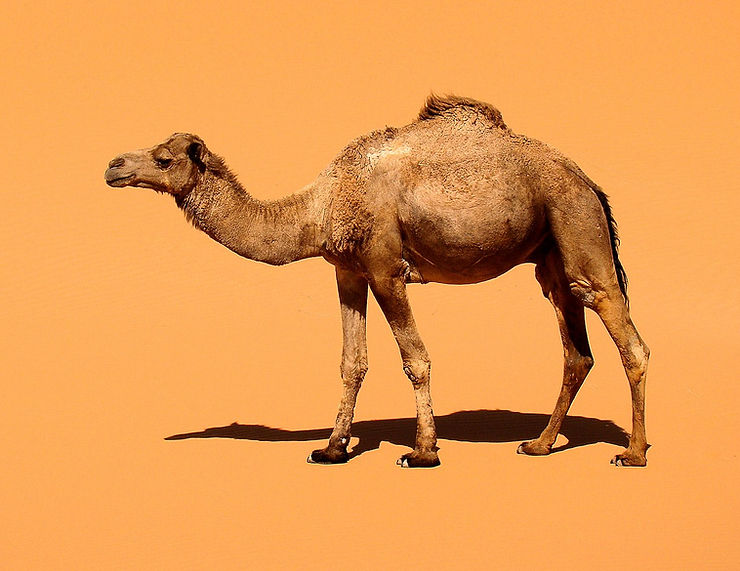
But how did the Ghana Empire come about? And why did West Africans take the lead in trade in Africa at that time? The answer is multifaceted. We can name favourable growing conditions and plenty of resources. But the biggest reason is that around the year 300, the area’s inhabitants managed to domesticate camels. Camels are excellent pack animals in desert climates, and their domestication revolutionised all trade across the rugged Sahara desert. The camel caused a complete social revolution. Ancient and little-used trade routes turned into a dense network of trade routes throughout the Sahara region, from Morocco to the Niger River. Out of this great social change, the Ghana Empire developed.
We see evidence that urban areas began to form at a similar time. As the number of urban centres increased and the community grew, the chieftains began striving for more land. Then it was easiest to conquer the country and kingdom of the nearest neighbour. Victorious rulers conquered smaller kingdoms and acquired ever larger territories. This development led to the administration becoming more centralised and in fewer hands. The Ghana Empire gradually emerged. However, we cannot say precisely when this happened. The 6th century is often mentioned, but evidence of governmental administration or politics is not seen until later.
As mentioned before, we can only base Ghana’s origin history on word of mouth. According to it, Ghana’s empire began with a man named Kaya Magar Cissé. He was the king of a realm called Wagadou. He came to power around 300; over the years, his heirs expanded the kingdom and conquered other powers. This dynasty of kings ruled the empire for centuries. Today, we know very few names of the kings, and little is known about their achievements, as the Ghanaians did not write anything down.

Culture, Religion and Government
The population of the Ghana Empire mainly consisted of the Soninke ethnic group. Those people spoke a Mande language, often called Mandingo, and lived on the grasslands between the Niger River to the southeast and the Senegal River to the southwest. These two rivers, together with the Sahara Desert to the north, framed a triangular grassland area that became the homeland of the Ghana Empire. This area where the Sonike people lived was called Wagadou among the natives or Wangara by Muslim geographers.
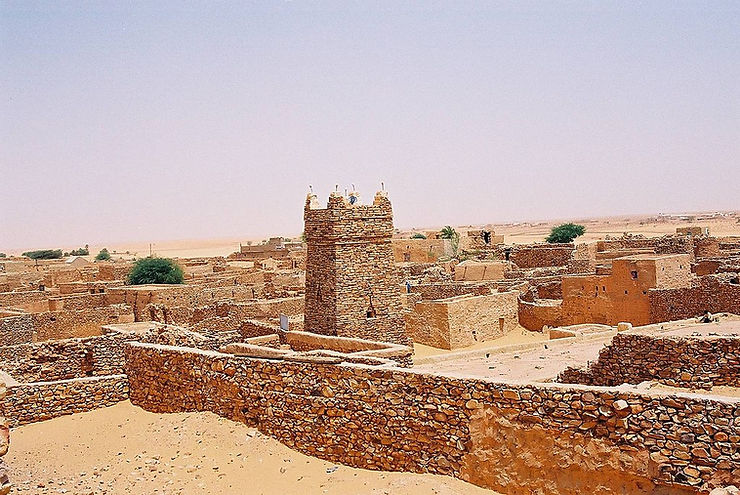
Most scholars believe that the state’s capital was the city of Koumbi Saleh (sometimes also called Ghana), although scholars are still debating it, and there is no firm evidence either way. Arabic sources from the Middle Ages speak of a population of forty to fifty thousand. Still, based on the latest archaeological research, that seems too small, as the city seems to have covered more than half a square kilometre. In addition, many other population centres and towns are found all around the city, indicating that the city was large with scattered suburbs. Historians even believe the capital consisted of two residential cores 10 km from each other with a dense population.
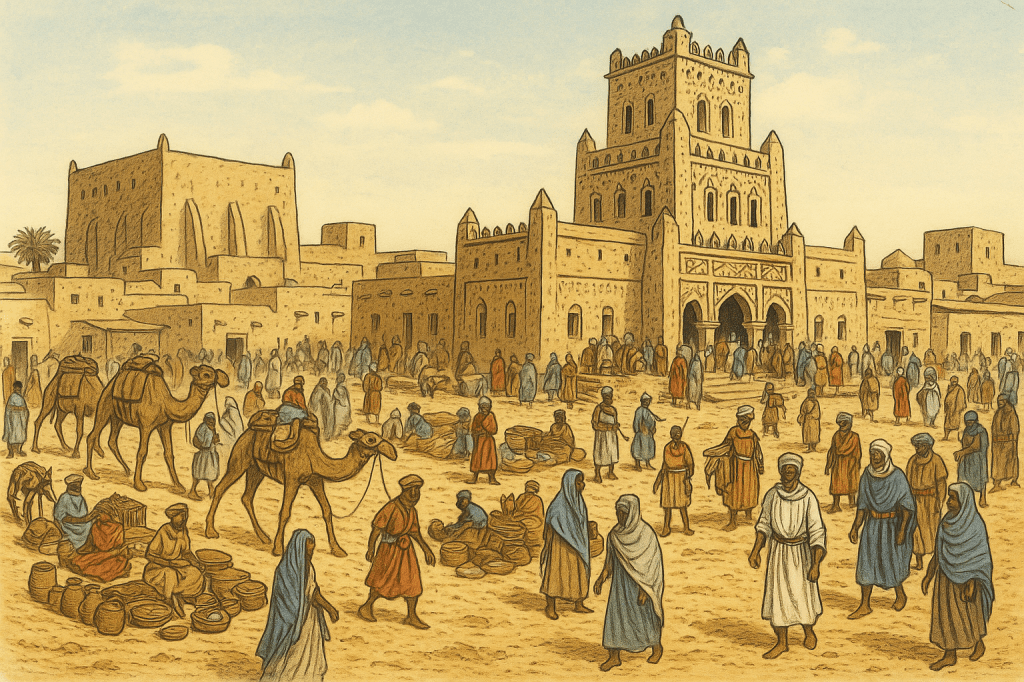
Large mosques, public squares, fortifications and gates have been excavated during archaeological research. The houses were usually one-storey and made of sun-dried mud bricks, compacted soil, wood and stones. A material still used today. The Arab wanderer Al-Bakri of Cordoba travelled to the kingdom in 1076 and described irrigation ditches, wells and vegetable fields. He also talks about the king’s palace, domed dwellings, city walls and the residences of the magicians who control the inhabitants’ religious practices.
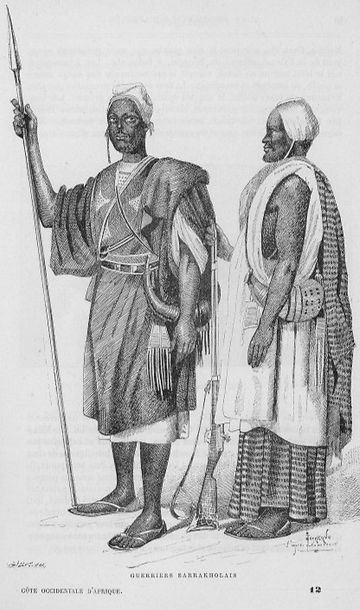
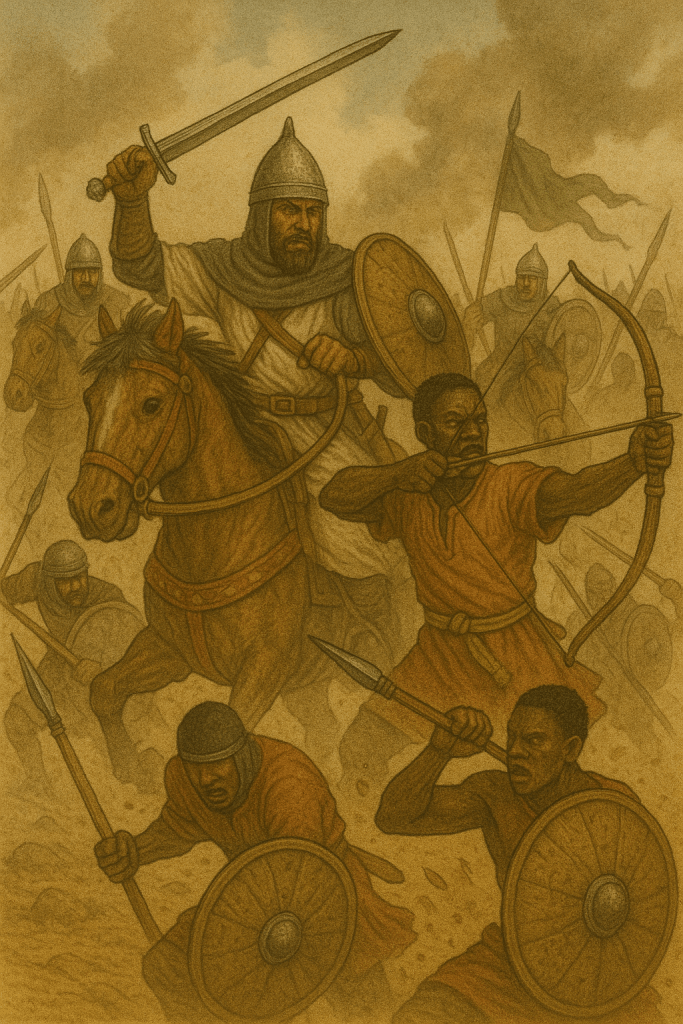
The kingdom was, at its core, just a collection of villages ruled by one king. The empire prospered and was stable because it had a well-trained army and access to raw materials to make weapons and gold to pay soldiers. According to one Arabic source, the kingdom’s army consisted of two hundred thousand warriors and forty thousand archers. We also know that the military had cavalry, which is not mentioned in this source. Sources from earlier centuries about the size of armies are almost invariably exaggerated and must be taken with great caution. It is improbable that the Ghanaian Empire had an army of nearly two hundred and fifty thousand men. But the fact remains that the military was so large that it surprised visitors and enemies alike.
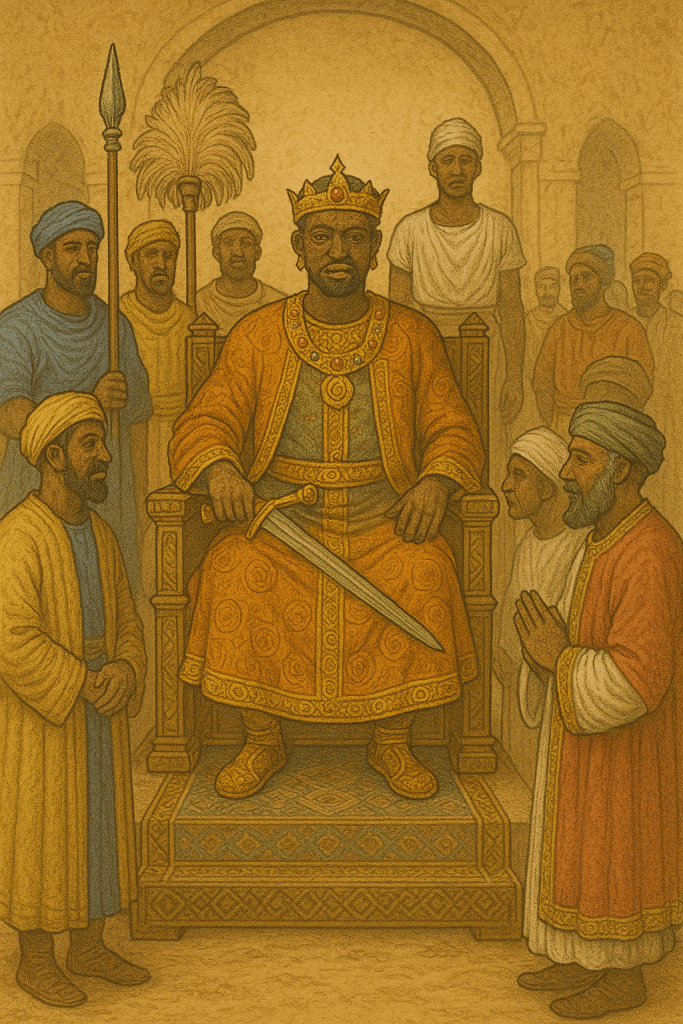
The king was an autocrat, and the tribe created a certain mystique around him. This was partly down to his role as the leader of the spiritualism practised in the kingdom. The people made worship and sacrifices in his honour. Stringent social rules were in force in the king’s presence, and when he died, he was laid to rest in a sacred place that no one was allowed to visit.
We get invaluable descriptions of the king from Al-Bakri of Cordoba. He tells us the king decorates himself like a woman with necklaces and bracelets. When he comes before the people, he puts on a large headdress decorated with gold and wrapped in a turban made of fine cotton. And although the king was autocratic, he needed help and relied on advisors to help him run the kingdom. From the 11th century, the king began to hire Islamic traders to interpret for him in his dealings with other Muslims. He even appointed some of them to the administration controlling the economy and trade.

The tenets of Islam spread throughout the kingdom through Islamic merchants. The kings of the empire saw an opportunity. They quickly noticed they could boost trade through improved relations with Islamic states. They decided it was in their best interest not to fight this strange new custom and embraced it. Some citizens embraced the religion sincerely, while others pretended to embrace the faith to prosper in trade and commerce. Yet, there is no evidence that the kings of Ghana ever embraced Islam.
This coexistence of religions is visible in the capital city of Koumbi Saleh. Muslims inhabited one-half of the city, as twelve mosques have been found in that part. In the other half are the king’s buildings and that of the traditional religion. This division reflects that animism and Islam coexisted for some time. It also seems that animism lived longer in rural areas while Islam spread in cities. But eventually, the traditional African religions began to decline, and Islam became dominant.
Economy and the Basis of Prosperity
The basis of prosperity in the state was through trade in goods and resources. The Ghana Empire dominated trade in Central West Africa from the 6th or 7th century and well into the Middle Ages. Trade in Ghana was lucrative because the country had abundant resources and fertile soil for cultivation. There was plenty of iron, copper, gold and ivory in the country. The merchants of the Ghana Empire exported these resources and other products, such as iron tools, weapons, furniture, clothing, spices, foodstuffs, skins and ostrich feathers. Conditions for trade and manufacturing were most pleasing. The Niger and Senegal rivers acted as trade highways, and the camels carried goods to Arab traders in the north.
The Arab traders sent goods back south across the Sahara desert. The aristocracy bought fine textiles, pearls and Arabian horses. Ghanaians were also very keen on an expensive product that the Arabs had for sale – salt. Many goods passed through the country on their way to other countries, as Ghana was well located on the main trade routes. Goods were often taxed twice when they entered the country and again when they left it. The king kept the proceeds.
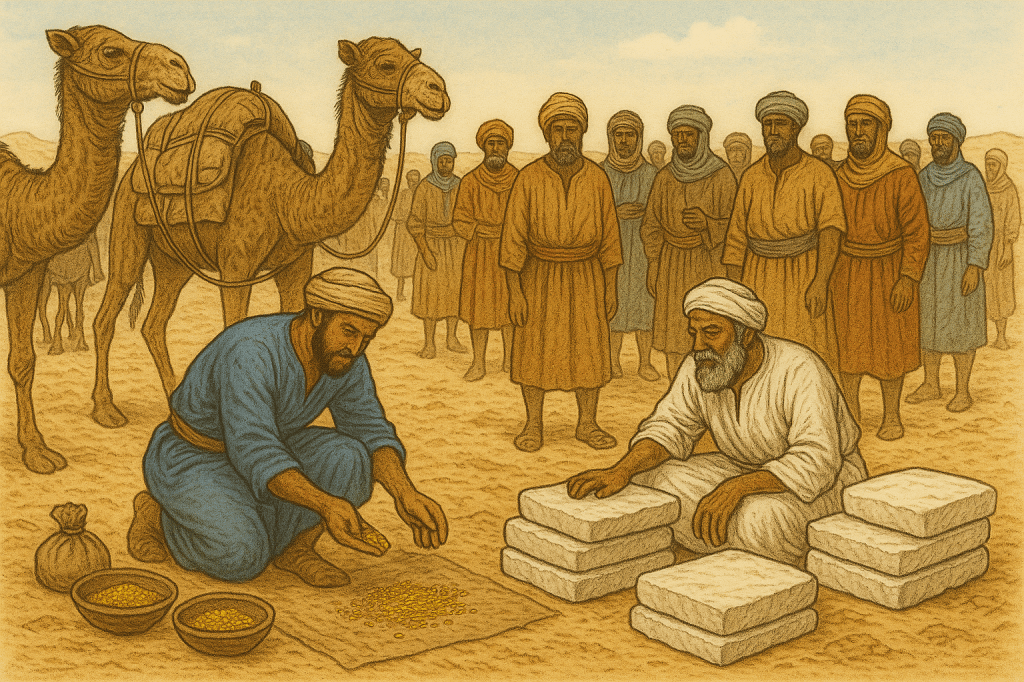
And then there was the gold. The Arabic writer Al-Hamdani described how Ghana possessed the greatest gold mines on earth. We know that the kings of Ghana accumulated a large stock of gold nuggets, as they had the exclusive license to collect them in the kingdom. Ordinary merchants were only allowed to handle gold dust. The king controlled the gold market and could control supply and demand. As European power declined after the fall of the Roman Empire, Ghana became known both in North Africa and Europe as the “Land of Gold”.
This period also marks the beginning of one of the most fateful mistakes in human history. Ghanaian merchants and rulers started massively exporting enslaved people from West Africa to the Islamic world. They sold other Africans out of the country. This slave trade was to have devastating consequences for the following centuries. When the Portuguese arrived in West Africa centuries later, this slave trade grew even more, ending with the sale of enslaved Africans to the New World.
The End of Ghana
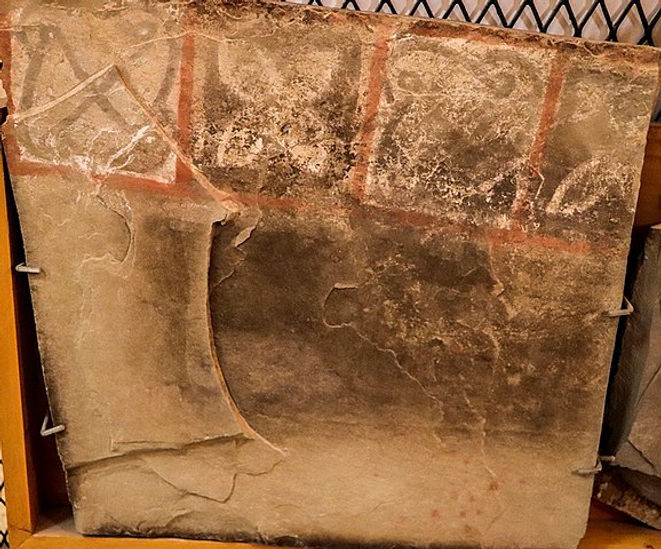
The first signs of Ghana’s decline began in the mid-11th century. In 1076, the capital fell to the Almoravid kingdom of Morocco after a five-year war. The Almoravid Empire was likely retaliating against the attempts of the Ghanaians to encroach on their trade in North Africa. The Ghanaians recaptured the capital but never really recovered. However, there is no evidence that the Almoravids occupied the country. They seem to have gone back home after the war.
In the 11th century, Islamic officials and Berber merchants began to assert themselves and assumed considerable power within the state. Muslims got into good positions, including as state financial directors and diplomats. Some sources claim that by the 11th century, Muslims had become a majority within the bureaucracy.
It was in the 12th century that the empire fell. There are many possible reasons for this. The combined effect of all the reasons likely caused the kingdom to fall. First, new trade routes opened up in the east that directly competed with Ghana’s trade routes. Second, increased animal husbandry in Ghana destroyed vegetation, and droughts in the region undermined the cultivation of necessities. Third, the kingdom’s rulers were not helping with the perpetual feuds and civil wars. Many rebellious rulers took advantage of the opportunity and declared themselves independent from the empire.
The Kingdom of Sosso, supported by the Almoravids, took over most of the Ghana Empire when it collapsed. But the Sosso kingdom was short-lived and was defeated by Sundiata Keita, who later founded the Mali Empire in 1240. The Mali Empire became the most extensive and richest empire that Africa has ever produced.
The Decline of West Africa
The Ghana Empire existed when West Africa was at the same level of development as other regions in Europe, Africa and America. There was no distinct difference in technology and level of evolution between medieval Europe and West Africa at this time. If anything, Africa prospered better.
The good times ended when the European slave trade began in the 16th century. Europeans bought enslaved West Africans by the millions and brought them to America. This flesh trade had a massive impact on the population and was a huge brain drain. Thousands of people who could have built up the society, invented new technologies and contributed to construction and progress were transported in irons to another continent.
It is a common misconception that slave hunters enslaved only ordinary people and workers. All the foremost experts, engineers, soldiers and officials of the continent were suddenly taken away in irons. The slave trade caused irreparable damage to social structure and knowledge in West Africa. The region could not keep up with technological development as before, fell behind, weakened enormously and became easy prey for nations with colonial dreams. It’s like someone hit the pause button. It is interesting to speculate how West Africa’s evolution would have been had the slave trade not come into being and whether mighty powers such as the Ghana Empire would have been able to gain influence beyond the continent.


 The Past World
Leave a comment