
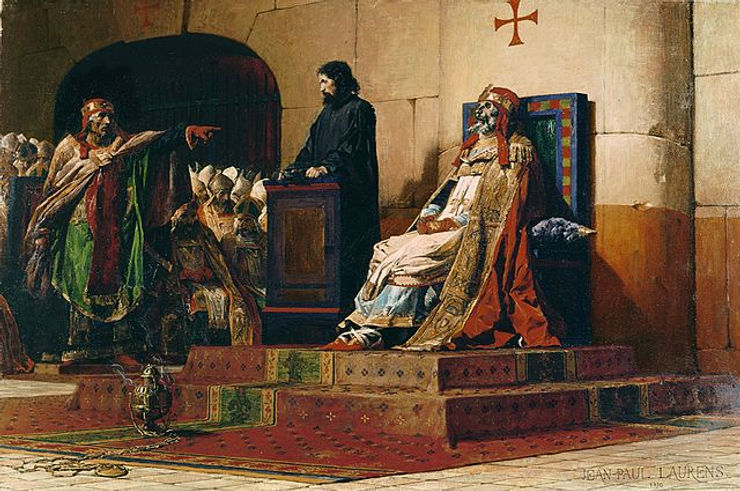
Pope Stephen VI is on all lists of the worst popes in history. He is best known for holding one of history’s most infamous and strange synods. The Synod was called Synodus Horrenda in Latin, but the name Cadaver Synod or Cadaver Trial is attached to it in English. After all, this was perhaps more of a trial than an actual synod. The only role of the assembly was to convict the body of Pope Formosus, which Pope Stephen VI had exhumed, clothed in full regalia and tried for misconduct. Needless to say, of course, there is a death metal band called Synodus Horrenda.

Challenging Times for the Papacy in the 9th and 10th Centuries
Not much is known about Stephen VI’s life before he became Pope. He was born in Rome, but we do not know when. His father’s name was John, and he was a priest. Stephen VI was only incumbent from May 22, 896, until his death in August 897. Pope Formosus (891-896) appointed him bishop of Anagni, and the appointment was likely against Stephen’s own will.
His election as Pope was political like all other such elections at that time. He sat on the papal throne for over a year, which was not uncommon during the tumultuous times in Italy in the 9th and 10th centuries. Between 872 and 965, around thirty men were Popes, and between 896 and 904, a new pope was elected every year.
Who sat on the papal throne depended on which faction in Rome, Naples, Benevento, Tuscany, or Spoleto were on top at any given time. Sources from this time are often vague on the chronology and events. For example, we do not know precisely how Stephen VI was elected Pope, but we know that he came into power because he was connected to the Dukes of Spoleto, who were powerful in those years.

Historical Context
Stephen VI succeeded Pope Boniface VI, who in turn had succeeded Pope Formosus. Boniface VI is of little importance to our story, as he only lasted fifteen days in office in April 896. However, his predecessor Formosus managed to hang on to the office for five years and plays an essential role in this tale. His reign was stormy as he was constantly involved in power struggles with the Patriarchate of Constantinople, the West Frankish Empire and the Holy Roman Empire.
The relationships and history of these characters and families are very complex. But the simple story is that Duke Guido III of Spoleto was crowned Holy Roman Emperor in 891 by Pope Stephen V (Formosus’ predecessor). Guido’s son, Lambert II of Spoleto, was crowned co-emperor with his father by Pope Formosus a year later. The coronation took place against the wishes of the Pope, but he had no say in it, as Lambert of Spoleto and his mother, the magnificent Ageltrude, held all the power in Rome.

The Pope wanted Arnulf of Carinthia, king of the East Franks, to become emperor. The Pope sent men to meet Arnulf and asked him to invade Italy and wrest power from the hands of the Spoleto family. However, Arnulf’s invasion in 893 failed. When Guido III died of illness in 893, Lambert assumed all his father’s titles. The Pope still feared the power of the Spoleto family and still desired Arnulf’s help. Arnulf finally invaded Italy again and captured Rome in February 896.
Formosus crowned Arnulf emperor and deposed Lambert. But eventually, Arnulf returned to Germany to administer his kingdom, and Pope Formosus died. Lambert then took back all power in Rome and many areas of Italy.
After the death of Formosus, Boniface VI became Pope for a full fifteen days. After his reign, Lambert of Spoleto placed his client, Stephen VI, on the papal throne. In early 897, Lambert travelled to Rome to have Pope Stephen VI formally re-crown him as emperor. Still full of hatred for Pope Formosus, Lambert convinced Stephen VI to hold the infamous Cadaver Synod.

The Cadaver Synod
Pope Stephen instructed that the body of Formosus be exhumed and brought before the Synod in Rome. The nine-month-old corpse was dressed in papal robes and placed on the papal throne in the Lateran Church. A deacon got the task of speaking on behalf of Formosus.

One of the main charges against Formosus was that he had been both bishop of Porto and bishop of Rome. Church law stipulated that clerics could only be ordained at one episcopal see at a time. These rules were put in place to prevent clerics from amassing bishoprics. The Pope is the Bishop of Rome, and by being both the Bishop of Porto and the Pope, Formosus violated canon law.
Various other minor charges were put forth. But the charges themselves did not matter. The real purpose of the trial was to appease the Spoleto clan and achieve political revenge.

Pope Formosus (or what was left of him) was found guilty. The body was stripped of the papal vestments and insignia, and three fingers of the right hand were cut off from the body (the Pope uses three fingers of the right hand to bless the congregation). Next, Formosus’ tenure was declared invalid, and all his actions and appointments in office were declared null and void.
This sentence had the bonus effect that Pope Stephen’s appointment as bishop of Anagni became invalid. Stephen had violated church law himself regarding illegal transfers between dioceses when he became Pope. He became both bishop of Rome and Anagni at the same time. Stephen himself had therefore broken the law for which he was judging Formosus. It shows how much of a farce this trial was.
Formosus was eventually buried in a cemetery for unknown foreigners. However, he was dug up again a short time later, a weight was tied to him, and he was thrown into the river Tiber.

The Aftermath for Stephen VI and Ten Years of Strife
This farcical trial made Pope Stephen VI extremely unpopular in Rome. In addition, the body of Formosus washed ashore, and rumours spread that miracles were connected to the body. A revolt by the public caused Stephen to flee from office. He was imprisoned and strangled in prison in July or August 897.
Romanus was ordained as Pope after Stephen. However, he was only in the office from August to November of the same year; sources say that he was deposed and retired to a monastery. We do not know which faction deposed him. Stephen’s faction felt that he did not condemn Formosus enough, and Formosus’ supporters wanted him to condemn Stephen more eagerly than he did.
For the next ten years, the factions of Formosus and Stephen continued to fight. The next Pope after Romanus was called Theodore II. He convened a Synod in December 897, which annulled the decision of the Cadaver Synod, acquitted Formosus and ordered that his body, which had been fished out of the Tiber, be buried in St. Peter’s Church in full regalia. It must be said that Theodore II was quite productive during the twenty days he was Pope. He died suddenly in office, and the cause of his death is unknown.

Next, John IX became Pope. He was Pope for two whole years (January 898 – January 900). He held synods in Rome and later in Ravenna. Both synods confirmed Theodor II’s ruling on the Cadaver Synod. John IX also had all the documents of the Cadaver Synod burned, excommunicated seven cardinals who took part in the session and banned all trials over dead bodies.
But the story did not end there. Four years later, Sergius III became Pope. He was in office for over seven years. After all, he wanted nothing more than to become Pope. To seize the position, he had two of his predecessors assassinated. His son later became Pope. It’s no wonder that Sergius III is on most lists of the worst popes in history, along with Stephen VI.

The reign of Sergius III is, however, significant for the development of this story in that he had taken part in the Cadaver Synod as one of the judges. He valued it so much that he annulled Theodore II’s and John IX’s decrees, reaffirmed the verdict over Formosus and had a laudatory epitaph placed on Stephen VI’s tomb.
Pope Stephen VI is on every list of the worst popes in history because of the infamous trial. Still, one has to wonder how much of it was really his decision and how much was the decision of the family that put him in power and wanted revenge on his predecessors.

Leave a Reply