
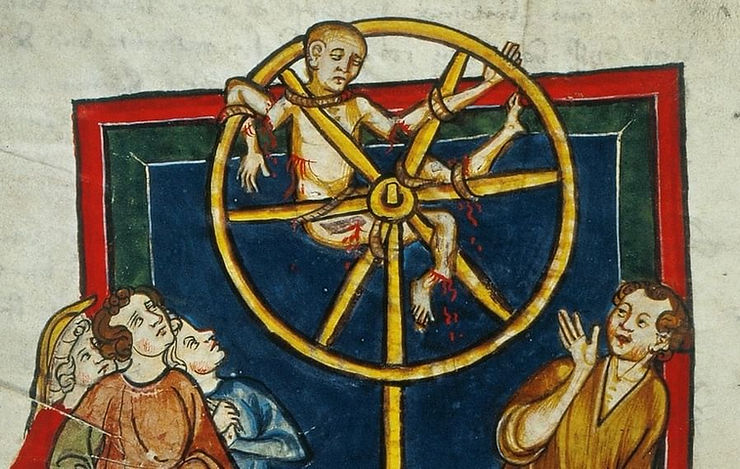
Gruesome torture and torture devices have become the symbol of the medieval period. You can hardly watch a movie or TV show about the Middle Ages without someone being tortured. Why do we think torture was more common in the Middle Ages than in other times? Historians frequently show in their research that people tortured other people in ancient times and continue to do so today.

About Torture in the Middle Ages
Torture was legal and commonly practised during the Middle Ages, with few exceptions. For example, under secular law in England, authorities did not allow torture. People didn’t use torture randomly for revenge or to harass others. It was part of the legal system. The aim was to get people talking. During the Middle Ages, however, there already were views that confessions under torture were unreliable, and sometimes authorities forbade torture in court cases where there was only one witness.
Some methods used at the time are called “torture” today, even though they are hardly that. Devices like the pillory were not dangerous to the life or limbs of the offender. The pillory was used to punish all kinds of lawbreakers. The captive was put in a pillory for several hours, mainly for public humiliation. Physical injuries were minor; the prisoners experienced stiffness and soreness in their muscles but hardly more than that. And women were allowed to sit on a chair when they were sentenced to the pillory.
Of course, more robust methods were used to punish and torture, and often there was little or no restraint in brutality. But scholarly research reveals that people in the Middle Ages didn’t have nearly as much imagination as we suppose. Archaeological studies that have been carried out along with paintings from the era have shown that medieval man used more straightforward methods than we think. The torturer starved people, hung them by the hands, burned the soles of their feet, or disturbed or prevented sleep. Interrogators also used simple mental methods such as threats of further torture or extended stays in a dark dungeon. The medieval man was practical and a bit boring when it came to torture.
Torture was no more common in the Middle Ages than at other times. And many of the torture devices we associate with the Middle Ages are later inventions. Torture was not a significant feature of this period of human history, contrary to the impression one gets from reading and watching entertainment about the period.
Our Ideas
Our ideas about torture in the Middle Ages reflect misconceptions about how widespread it was and how people practised it. We tend to think of ourselves as more civilised and intelligent than those who lived hundreds of years ago. We imagine they would be more willing to torture people brutally. That is why we allow ourselves to be convinced that devices such as the Rack, the Iron Maiden and the Pear of Anguish were everyday tools in the Middle Ages. It may say more about us than about our ancestors.
Many well-known instruments of torture have been attributed to the Middle Ages. We see their use in movies and TV shows and come across them in museums. There are tons of books on the history of torture, and all of them have an extensive chapter on the Middle Ages. I’ve also found an incredible quantity of online “top 10” lists that count the hideous contraptions. These lists are all more or less the same, copied from other lists without criticism.
When we look at these top 10 lists and various books about torture, it quickly becomes evident that few of the described tortures took place in the Middle Ages. The authors talk about “medieval torture” but often describe events and devices from the 17th to the 19th century. For clarification, the Middle Ages is the period from around 500 to 1500. Some writers of these pieces realise this and state that although there are no available records of anything before the 17th century, the same torture devices were “without a doubt”, or “certainly”, used in the Middle Ages. Such claims are never accompanied by any sources.
We also must remember that the Middle Ages was an extended period, a whole thousand years. Sure, there were wars and other catastrophes, but the social structure remained relatively stable. The period after 1500, however, was characterised by a social structure with increased cruelty and torture, bloody religious disputes, and the dissolution of old values. It, therefore, makes more sense to look at Early modern Europe as a period of torture rather than the Middle Ages.
Historians have increasingly begun to study torture devices attributed to the Middle Ages in recent years. They have realised that the vast majority of them are not from the Middle Ages at all. The devices date from the 17th to 19th centuries, and some were never used for torture in the first place. In this context, it’s good to remember that many people in the 19th century became interested in various dark subjects such as gothic novels, vampires and torment. Their imagination ran wild and often steered to the macabre. Many torture devices were invented during this time as curiosities and attributed to the medieval period. Many instruments from previous centuries were also available to them. If they could not guess what they were invented for, they imagined it was for torture and created morbid stories around them.
But let’s get to the fun part. The devices themselves…
The Iron Maiden
One of the most iconic torture contraptions from the Middle Ages never existed. The Iron Maiden is an outright fake. The first records about the Iron Maiden are from the end of the 18th century. Writer Johann Philipp Siebenkees portrayed such a device in a travel guide to the city of Nuremberg. He describes how a criminal was executed in the town in 1515 using a device that resembled an Egyptian stone coffin with doors. A person was placed in the coffin, and sharp stakes inside the door pierced the body when the door was closed.
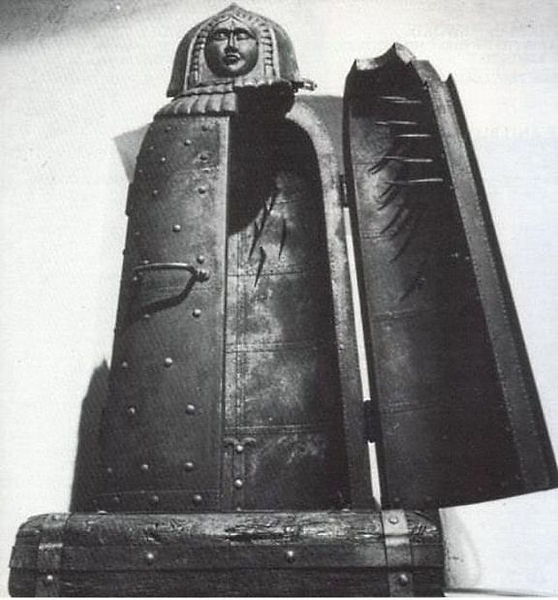
According to Siebenkees, the stakes pierced various body parts such as the eyes, stomach and genitals, but did not go deep enough to kill the person. The prisoner was wounded in the coffin and screamed for two days until he died. We know now that Siebenkees invented this story to spice up his travel guide. There are no records of this type of punishment in the city.
But right at the beginning of the 19th century, a copy of the Iron Maiden from the handbook was displayed in Nuremberg. One such specimen was even sent to the Chicago World’s Fair in 1893, further spreading the legend. The Iron Maiden from Nuremberg was destroyed during World War II, but long before that, it was known to be a fake. Despite that, there is still a misconception that the Iron Maiden is an actual torture device from the Middle Ages, and some books even claim that it was used as early as the 12th century.
Pear of Anguish
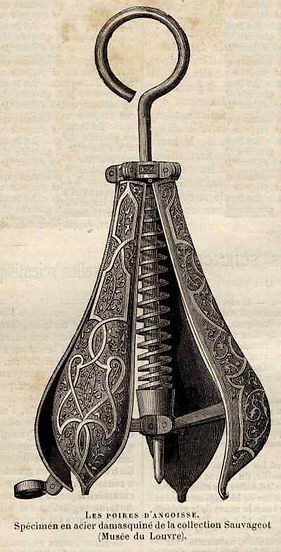
The so-called Pear of Anguish graces every online top 10 list of medieval torture devices. Many medieval museums house a copy of the device, which is claimed from the Middle Ages, although scholars have little idea where the device comes from. The instrument is pear-shaped with a lock or screw at the top. When the lock is pressed, a spring opens the device’s blades. We can then screw the blades back together with a key. Purposedly, the device was inserted into the victim’s mouth, vagina or anus and then opened, so the blades pushed out. Thus it caused immense pain and even tore the body openings.
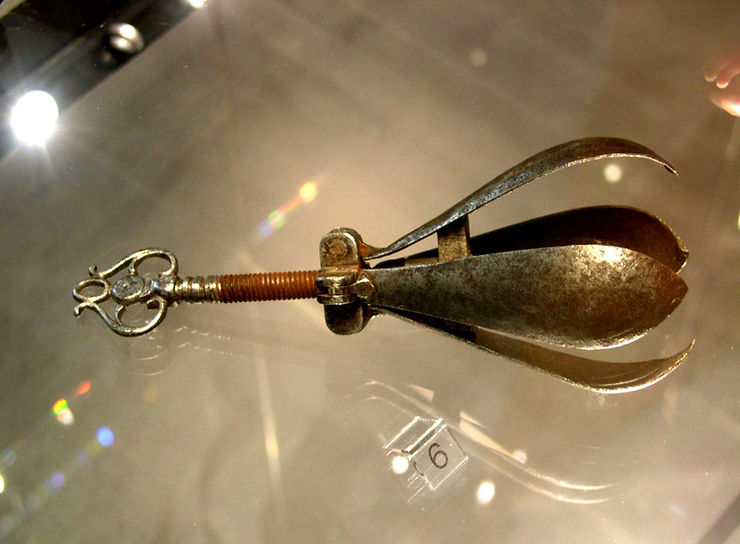
Australian historian Chris Bishop has studied the Pear of Anguish (see here). According to his research, the device first appeared in the 19th century. However, in the 17th century, we have a record of a pear-shaped object that a well-known criminal had made for him. This device was intended to silence his victims, but it is not certain whether this is the same object. There is no mention of such a torture device in the Middle Ages.
A further study of this device shows that it is impossible to use it for torture. The springs are too weak to open the orifice, and the design of the latch means that the pear cannot be opened when it is inside something. Bishop says no one knows what the device was originally intended for. Maybe it was the prototype of some invention that never came to fruition. When someone suggested that it might have been a torture device, the idea became very popular, especially among the torture museums in Europe that lacked instruments in their collections.
Breast Ripper or Iron Spider
The Breast Ripper, sometimes also referred to as the Iron Spider, is one of the most talked about torture devices of the Middle Ages. However, the Breast Ripper did not exist in the Middle Ages. According to folklore, the Breast Ripper may have appeared in Germany at the beginning of the 17th century. It is said to have been used until the 19th century. It isn’t easy to know how much authorities used it. There is little or no confirmed evidence of the use of the torture device.

Legend has it that it was used to interrogate and punish women accused of adultery or abortion. The device was made of iron and was heated up to brand women’s breasts or to shred the breast tissue. The user clamped the device’s four claws over the woman’s chest. The torturer slowly turned the device and pulled until he completely tore off the breast tissue. If the woman survived the ordeal, the Breast Ripper marked the woman for life as a criminal, and she could not breastfeed children.
Another similar device is the so-called Iron Spider. This device was attached to a wall, and the chest of the accused was attached to the claws of the device. The accused was then pulled from the device so that it tore off her breast.
The Rack
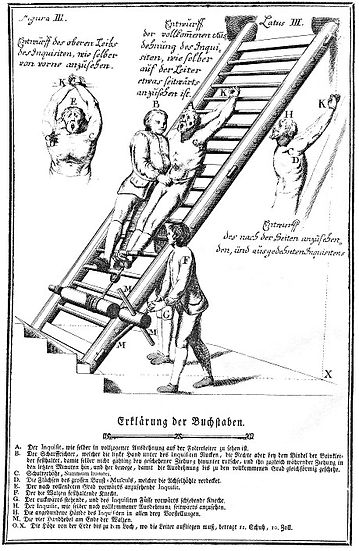
The famous Rack is a torture device made of a rectangular wooden frame with a roller on one or both ends. The victim’s ankles were tied with rope to one roller and the wrists to the other. Then a traction device was attached to the upper roller, which pulled the rope in, thus increasing the stress on the victim’s shoulders, hips, knees and elbows. With pulleys and levers, it was possible to turn the roller around its axis and thus stretch the ropes until the victim dislocated.

One of the scariest aspects of the Rack was the clicking sound when cartilage, ligaments or bones gave way. Having someone listen to or watch another person being tortured on the Rack was torture, and the person usually confessed when they saw what was coming. A person attached to the Rack was also an ideal victim of other tortures. For example, burning the person with a candle or a torch was popular or working on them with tongs. Those tortured on the Rack usually did not live long or were permanently crippled.
We do not know the exact origin of the Rack, but the oldest sources about it are from ancient Greece. The historian Tacitus and others wrote about its use in the Roman Empire. But for us, the Rack is associated with the Middle Ages. We imagine there was a Rack in every dungeon in every castle. But medievalists point out that there is only one such devise from this period, which is from the end of the Middle Ages. That copy is kept in the Tower of London, which arrived in 1447. There are no other sources about the use of the Rack or a similar device in the Middle Ages. Its use was first mentioned in the middle of the 16th century and was quite widely used in the 17th century and later.
The Brazen Bull
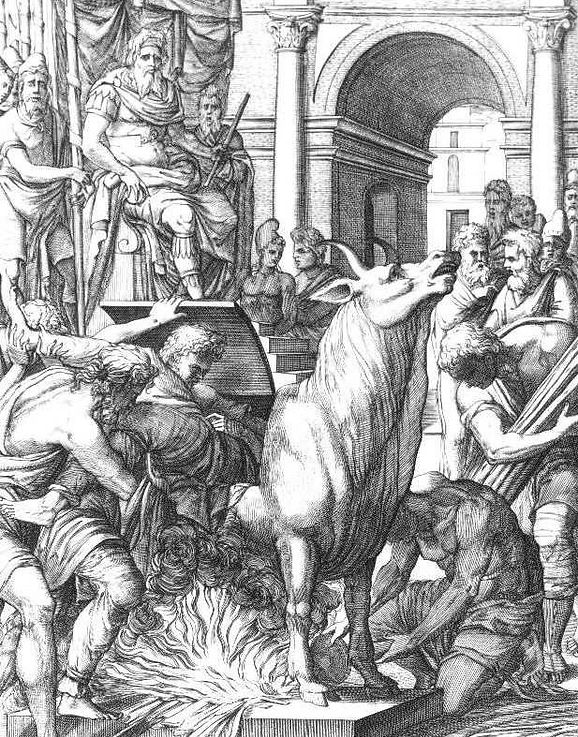
The Brazen Bull is another instrument of torture mentioned in lists of medieval torture devices, although people did not use it in the Middle Ages at all. The Brazen Bull, sometimes referred to as the Sicilian Bull, is said to have been invented in Greece in the 6th century BC. Today, many scholars doubt that the Brazen Bull ever existed. Such a bull has never been found in any archaeological excavation. That is perhaps not that strange since metal was valuable, and if such bull existed, it must have been melted down eventually.
According to Diodorus Siculus, Perillos of Athens invented the bull for Phalaris, a tyrant of Akragas in Sicily. In his story, the Brazen Bull was the same size as a regular bull, hollow inside with a door on the side. The victim was locked inside the bull, and a fire was lit under it. The metal heated up, and the victim was grilled to death.
There are occasional stories after this about the use of such a bull. We find several stories of early Christians being burned in the Brazen Bull by Roman emperors. The Roman usurper Burdunellus is said to have been roasted in such a bull by Alaric II in 497. There are no records of the use of the Brazen Bull after that.
Sawing
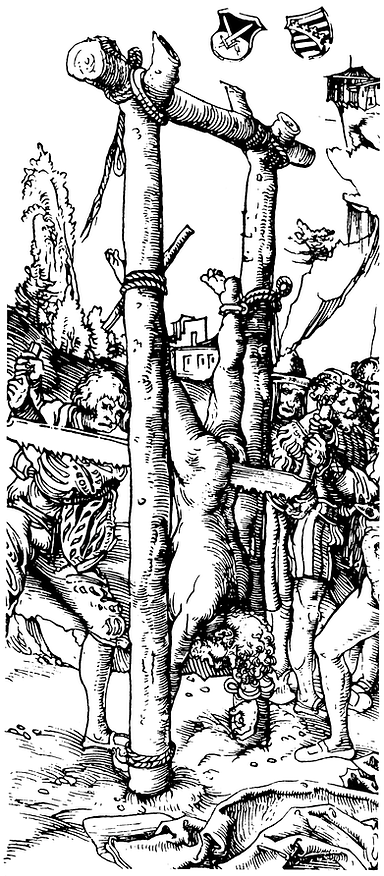
This method is quite incredible to a modern man, but there are plenty of stories about it. The method is simply that a living person was cut in half, either lengthwise or crosswise. Technically speaking, this is more of an execution method than torture. But since this method often features on medieval torture lists, we’ll discuss it here.
We can find stories and records of this method from the Persian Empire, the Kingdom of Judea, Thrace, and the Roman Empire (mainly Caligula’s rule). One tale describes Armenians who were cut in half by the Turkish emir Balac during the Crusades. Another story recounts that the Nizari assassins (see our article about them here) sawed enemy kings in half, but this is most likely a myth.
There are also numerous stories from later times. We have an account from 1630 about a Catholic monk who was sawn in half in Egypt. Two well-known cases arose in Morocco in the 18th century and the North American colonies. There are a few random examples of such executions in the Ottoman Empire and from states to the east. In Europe, there are very few examples. One example is from Almería in Spain in 1569, one from the La Mancha Rebellion in Spain in 1808, from Russia in 1812 and the Hungarian Revolution in 1848.
There are no records of people being sawn alive in Europe in the Middle Ages. Yet we can see claimed in printed books and on the internet that this was a common operation in the Middle Ages. On Wikipedia, for example, you can read this: “…reportedly used in different parts of the world, but most frequently in Medieval Europe.” Wikipedia lists dozens of examples of executions with saws, but none is from medieval Europe. Sawing was an occasional method when cruelty and madness gripped people. But it was never an organised part of the penal system.
The Thumbscrew
Yet another tool often featured on lists of medieval torture devices is the Thumbscrew. It is a simple tool. It is made of three vertical metal bars and a wooden bar that runs across the metal bars and moves up and down. The thumb is inserted into the device, and a screw presses the wooden bar down and crushes the thumb. Sometimes the wooden bar had sharp teeth that dug into the thumb to increase the pain. Thumbscrews are different in size, and one version was used for crushing toes.
But anyone who knows anything about history knows that thumbscrews date back to the Modern Era. We can see a pattern emerging in these torture device lists; history and torture enthusiasts mistakingly call everything that happened before 1900 “Middle Ages”.

The Rat Method
The rat method is a devastating method of torture that was immortalised in Game of Thrones. Of course, it was subsequently put on every list of medieval tortures. Yes, you guessed right, the method first appeared in the 17th century in Holland.
Diederik Sonay first used this method on his prisoners during the Dutch Revolution (1566–1648). He filled a bowl with rats and placed the bowl on the prisoner’s bare body with the opening facing down. Then he piled hot coals on top of the bowl, and the rats resorted to gnawing their way into the victim’s entrails to escape the heat.
This torture method was predominantly used in the second half of the 20th century. Augusto Pinochet, dictator of Chile from 1973 to 1990, often used the method on his political opponents. It was also used in Brazil during the military dictatorship from 1964 to 1985 and in Uruguay from 1973 to 1985. Argentina’s 1976-1983 junta used a different method on its prisoners. A tube was inserted into the anus or vagina, and the rats were thus led into the body.
The Rat Method, as seen in Game of Thrones, was never used in the Middle Ages, as far as we know. But rats are terrible, and it is quite conceivable that they were used to aggravate people at some stage. For example, Catholic prisoners claimed that during the reign of Elizabeth I (1533–1603), there was a “rat dungeon” in the Tower of London. The dungeon is supposed to have been located in pitch blackness below sea level. When the water levels in the Thames rose, water flooded into the cell and the town’s rats with it. They then began to bite the prisoners in the cell, who could not save themselves, as they were tightly bound.

Seating Devices – The Judas Cradle and the Spanish Donkey
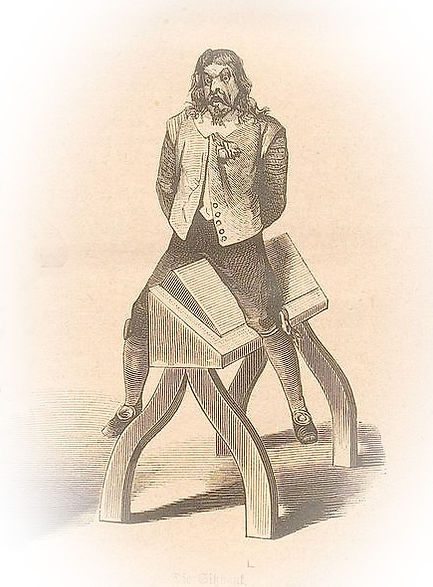
In the so-called Judas Cradle, the victim was lifted up and then eased down onto a pointed pyramid so that the tip rested against the anus, vagina, scrotum or coccyx. The individual conducting the interrogation determined how heavily he placed the victim on the pyramid’s tip. The victim could be rocked or repeatedly dropped on the tip to increase the pain.
Another similar device is the Spanish Donkey. The Donkey is triangular, with one end of the triangle pointing up. It is shaped to resemble a horse or donkey. The victim is made to sit astride the Donkey where the pointed part cuts into the victim. The torturer often placed weights on the legs to increase the pain and ensure that the victim did not fall off. As a result, the victim was crippled for life.
Both of these devices are popular in all lists of medieval torture devices. However, it is generally believed that the Spanish Inquisition first used these methods in the 16th century after the end of the Middle Ages. The Spanish Donkey also became very popular during the American Civil War. Union soldiers saddled Confederate prisoners into the Donkey until they passed out; many were disabled for life.
The Breaking Wheel
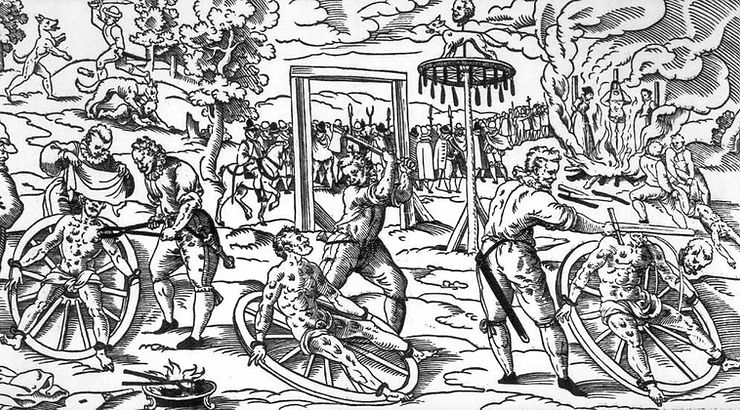
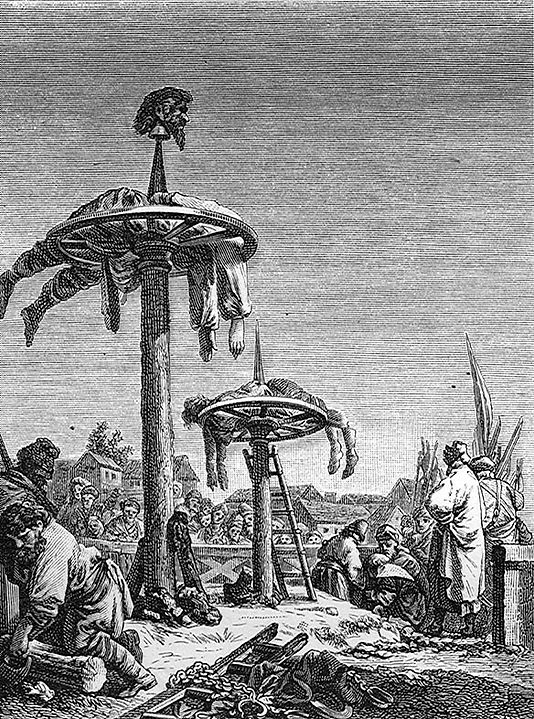
Then we finally come to a device that was verifiable in existence and used in the Middle Ages. Written records, archaeological finds and paintings from the Middle Ages support it. The Breaking Wheel, sometimes called the Catherine Wheel, was used in Europe from ancient times until the middle of the 19th century. Being “broken on the wheel” was a public event where the condemned was tied to a wagon wheel and then tortured by breaking his bones to prolong his suffering. Sometimes the victim was executed after the torture, but other sources tell of cases where the victim was hung on top of a pole (on the wheel) and left to die slowly from his injuries over the next few days.
Often the sufferer was left hanging as a warning to others while vultures feasted on him. This punishment was only used for severe crimes such as murder and grand theft. During the Black Death, this punishment was also applied to those who spread the disease, and Jews were particularly persecuted in this way.
Archaeologists have not found many skeletons broken on the wheel simply because the condemned were left hanging, often falling prey to the forces of nature and animals for years. However, here you can see a recent article about the discovery of a skeleton that has been dated between 1290 and 1430 and is believed to have been “broken on the wheel”. Amazingly, people did not abandon this method of execution until the middle of the 19th century. The last known execution took place in Prussia in 1841.
Scavenger’s Daughter
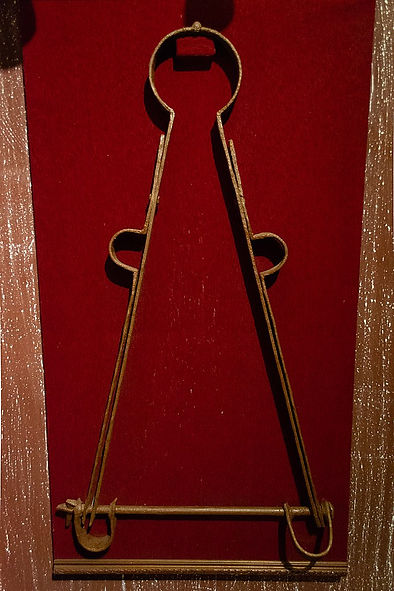
Yet another device is inexplicably included in the list of medieval torture devices. It was invented by Sir Leonard Skevington during the reign of King Henry VIII of England in the 16th century, mainly to torture Catholics. The torture device is a metal frame shaped like an A. The head was attached to the top point of the A, the hands to the middle, and the feet to the bottom. The A was then pushed together, the head bent down, and the knees bent up in a sitting position. The body was thus compressed until the blood was forced out of the nose and ears. The device was conceived as the opposite of Exeter’s Daughter (The Rack in the Tower of London), where the body was pulled apart.
The Head Crusher
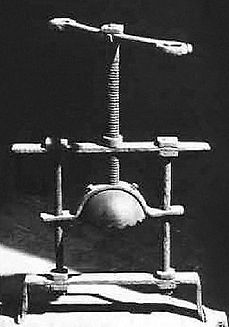
The Head Crusher is a torture device first used in the Early Modern Age but still ends up on medieval lists, like many other torture devices. The device was made of metal with a plate that sat under the victim’s jaw. A frame connected the plate to a metal cap, often called the “head cap”. As the torturer turned the handle, the gap between the metal cap and the plate narrowed so that the head was crushed in between, compressing the skull; teeth, jaw and other bones of the skull were broken. This almost always ended in death but was done slowly so that the victim suffered. Often the eyes were also pushed out of the eye sockets. To further increase the pain, the torturer sometimes hit the outside of the metal cap with a hammer.
Here I have only looked at the primary torture devices mentioned in the so-called top lists and books on medieval torture devices. Something is undoubtedly missing here, as the imagination of those torture enthusiasts is astonishing. Contrary to what we are made to believe, medieval historians maintain that medieval people used simple methods to torture individuals, as previously reported. All these creative devices are usually either late inventions or pure fabrications. If we study this subject carefully, we see that it is the modern man who has a gruesome appetite for torture rather than our ancestors.


 The Past World
Leave a comment