
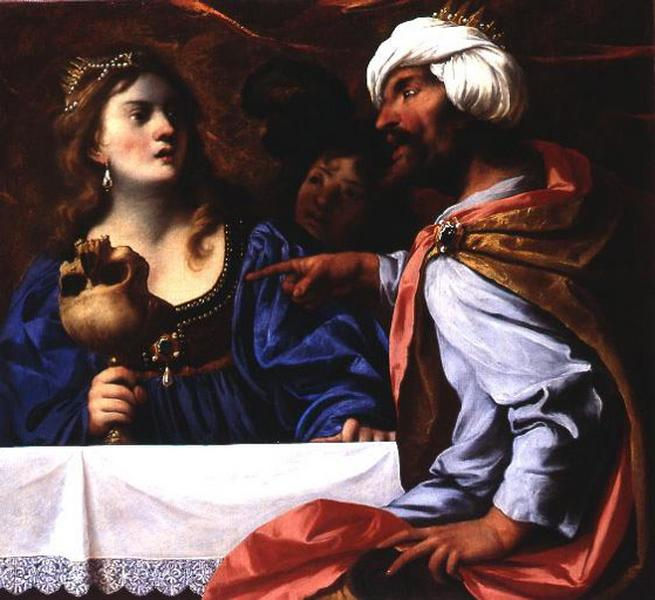
Alboin was a respected commander, politician and king of the Lombards in the 6th century. He conquered large territories, including large parts of Italy, and established the kingdom of the Lombards in Italy, ruling it successfully until his assassination. Today, he is probably better known for being murdered by his queen than for his career success. Many artists have painted works and composed compositions that refer to this event, either with Alboin or Rosamund in the role of the victim.

Who were the Lombards?
Alboin was the king of the Germanic Lombards (Latin: Langobardi). People called them Lombards because of how long they let their beards grow. The primary source we have on the history of the Lombards is the Historia Gentis Langobardorum by Paul the Deacon, which he wrote between 787 and 796. According to him, the Lombards were descendants of a small tribe called the Winnili, who lived in southern Scandinavia before moving south. However, Roman sources from the 1st-century state that Lombards were one of the Swabian (written either Suebi, Suevi or Suavi) ethnic groups that lived in what is now northern Germany around the Elbe river.
Whatever their exact origin, they had settled north of the Danube in what is now Austria and Slovakia by the end of the 5th century. There they defeated and drove away the Heruli. The Heruli originally came from Scandinavia, and some believe they retreated there after the Lombards conquered their kingdom. There is little proof of this, as with many things in the tumultuous times after the fall of the Roman Empire.
After the Lombards defeated the Heruli, they frequently warred with the Gepida. King Audoin of the Lombards defeated Thurisind, the leader of the Gepids, in 551 or 552. Alboin, his son and successor, finally defeated the Gepids in 567.
Alboin was considered a competent military commander and politician. He allied with the Avars, the neighbours of the Gepids to the east, and together they conquered their kingdom. Alboin beheaded Cunimund, the last king of the Gepids, and kept his head as a souvenir. He later had a drinking vessel made from the skull, which he kept on his belt. Many Germanic tribes believed that drinking from the skull of a defeated opponent gave them the wisdom of the victim.
To Italy
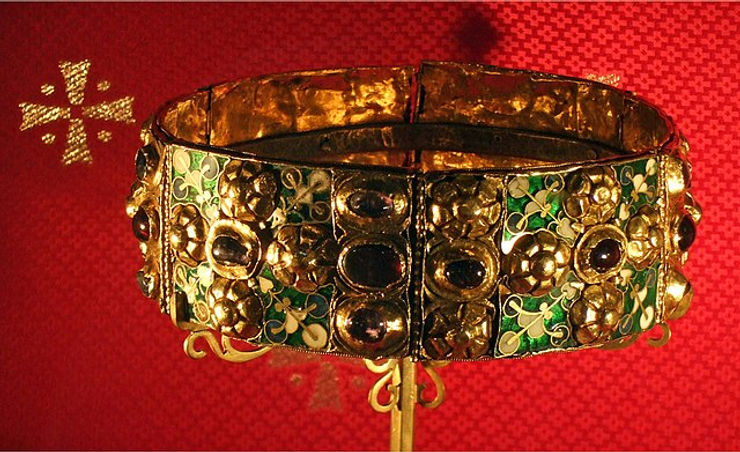
Immediately after the victory over the Gepids, Alboin decided to invade over the Alps into Italy. Adventurers from other Germanic tribes joined him. Italy was then in a bad position and struggled with population decrease after the difficult and long wars between the Byzantine Empire and the Ostrogoths (Gothic Wars 535-554). The provinces of northern Italy proved ill-organised and ill-prepared for such an attack, and they met little resistance. The Lombards captured Venice, Milan, Tuscany and Benevento, and in 572, they captured Pavia.
The Lombards also conquered areas of central and southern Italy. They established a kingdom that covered most of Italy except for the Papal States, which covered Rome and nearby provinces, and Sicily and the coastal regions of southern Italy, which were under the control of the Eastern Roman Empire. Pavia became the capital of the kingdom. The kingdom was called Lombardy but was later named Regnum Italicum or Kingdom of Italy. The kingdom lasted until 774, when Charlemagne defeated it. However, Lombard nobles ruled southern Italy well into the 11th century. The legacy of the Lombards is best seen in the fact that even today, the largest region of Northern Italy is called Lombardia. It is the most populous and wealthiest province in Italy.
With the combined victory of the Lombards and Avars over the Gepids, the Avars became very powerful, and they now threatened Alboin. To counter this, he decided to marry Rosamund, Princess of Gepida and daughter of Cunimund, to form an alliance with the Gepids against the Avars. He was also concerned about securing a male heir as he only had a daughter with his first wife. But the Gepids were now too weak to be of any use in the fight against the Avars. This reality is believed to be one of the main reasons why Albion decided to move his people into Italy.
The Marriage of Rosamund and Alboin
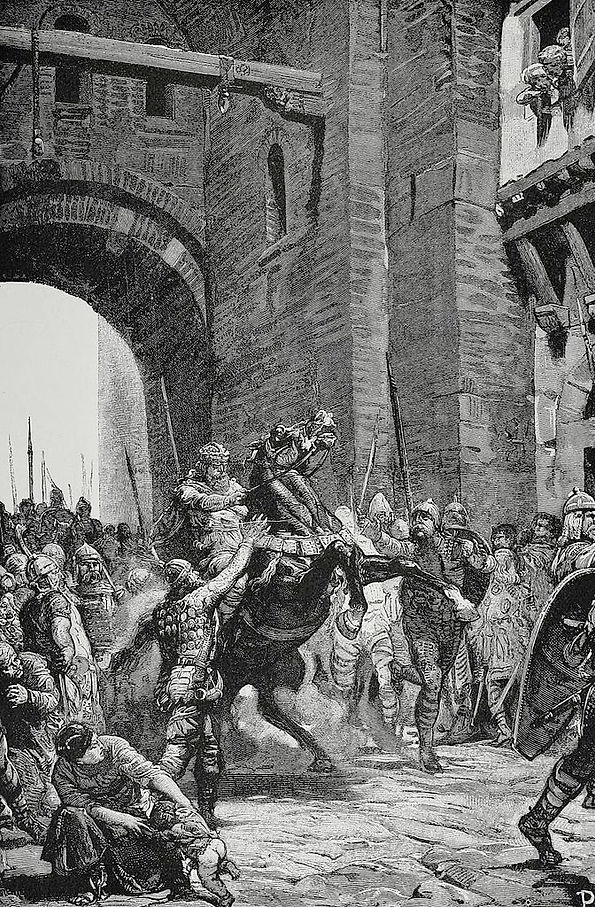
Rosamund had lost her grandfather and uncle in the wars with the Lombards. Her father had instilled a great hatred of the Lombards, which did not diminish when Alboin killed her father and took her prisoner. Rosamund was unhappy in the marriage, as it was only a marriage of convenience to secure the alliance with the Gepida. Also, Rosamund was Alboin’s prisoner when they married, her position was weak, and she could not refuse the proposal.
On top of this, according to Deacon Paul, Alboin mistreated his wife, abused her and belittled her. Paul reveals that Rosamund finally had enough in June 572 when Alboin got dead drunk at a party in Verona and asked for his wife to be served a drink in the vessel he had made from her father’s skull. He forced her to drink “happily with her father.” Rosamund felt a deep pain that she could not suppress if Paul’s account were anything to go by. She burned with a desire to avenge her father.

The Conspiracy
According to Deacon Paul’s story, Rosamund convinced her lover and Alboin’s foster brother, Helmechis, to kill the king and thus avenge her father. The carrot for Helmechis was that by getting rid of the king and marrying his queen, he could become king himself. According to Lombard tradition, those who married the widow had a claim to the crown. Other sources (Gregory of Tours or Marius of Aventicum) tell the story differently, but all sources agree that Rosamund formulated the plot.
Helmechis convinced Rosamund to get Peredeo to join them, but he is described as a “strong man” in the chronicles. Peredeo allegedly refused to participate, but Rosamund disguised herself as a maid, slept with him and blackmailed him into cooperation as it was a crime to sleep with the queen. In some accounts, Peredeo is just a simple butler who allows the conspirators into the king’s residence. In others, he is the assassin and even the mastermind. The sources disagree on who was the organiser and who was tricked into the work. It all depends on whom it was suitable to paint as the wrongdoers.
On June 28, 572, when Alboin was resting after lunch, Helmechis and Peredeo attacked him. Rosamund had previously ordered Peredeo to tie Alboin’s sword to the bed so the king could not use it. So he fought the attackers with his footstool but was eventually overpowered and killed. Sources differ on which of the men killed him.
The Epilogue of the Plot
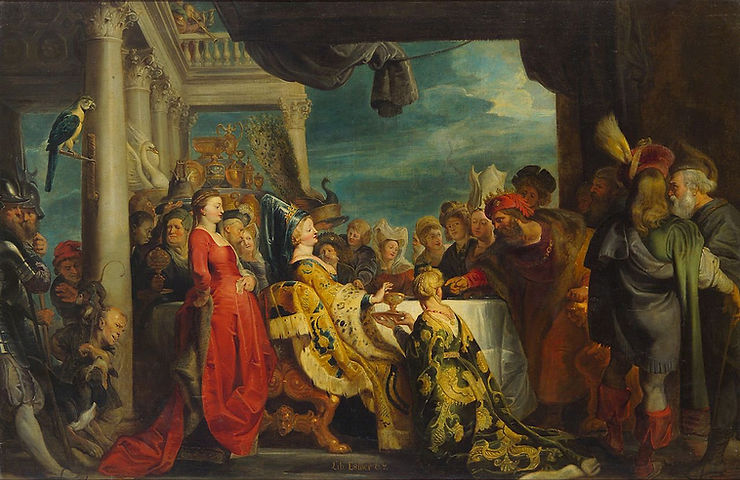
As a result, Helmechis declared himself King of the Lombards. However, the Lombards’ dukes refused to recognise him as the new king and instead elected Cleph, the duke of Pavia. Eventually, the three conspirators fled from Verona to Byzantine Ravenna along with Alboin’s daughter from a previous marriage, taking the treasury and part of the army with them.
The rulers of Byzantium were glad to get rid of a tricky opponent like Alboin, but all primary sources claim that the plot was planned and carried out by Rosamund herself. However, it is tempting for us modern sceptics to conclude that since Ravenna’s Byzantine rulers helped them escape and sheltered them, the plot was orchestrated by the Empire and Rosamund, only their instrument or cooperator. At least, the Byzantine Empire took the treasure they fled with and sent it home to Constantinople, together with Alboin’s daughter.
In Ravenna, Rosamund and Helmechis were married. Soon the couple’s relationship soured, and Rosamund decided to poison Helmechis. Some sources say that the Byzantine governor Longinus convinced Rosamund to do it to make their marriage possible (but they were having an affair at the time). But Helmechis knew his wife and suspected her. He forced her to drink from the poison cup before he drank it himself or afterwards. But in any case, they both died in each other’s arms.
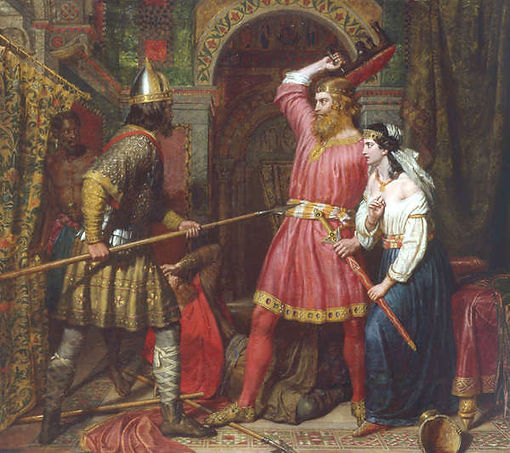
Heritage
Alboin is still remembered in Northern Italy as a great leader who secured a homeland for his subjects and ruled it well. But his life’s work has been overshadowed by the drama surrounding his death. Today, he is better known as a tragic figure in literature than a leader and king.
His death had a lasting effect on the kingdom of the Lombards. He was their only leader who could keep the kingdom decently peaceful. His death was the best thing to happen to Italy’s Byzantine Empire. Their goal was to establish a government in Verona that was sympathetic to them and, in time, completely destroy the state. King Cleph was deposed after eighteen months, and no king succeeded him. Internal strife characterised the kingdom of the Lombards for the next decade, and no agreement was reached on a new king until 584, when the Franks threatened the kingdom’s existence.
Rosamund herself became the inspiration for many literary works. Especially in Italy, where the folk song “Donna Lumbarda” was passed down from person to person for many generations and inspired later works about the event. In the Middle Ages, the story became very popular, and the first tragedy about the events was published in 1525 by Giovanni Rucellai, simply called Rosamunda. The work became the basis for subsequent works on the same subject.
You can read The History of Lombardy by Paul deacon in the English translation by William Dudley Foulke from 1907 here.


 The Past World
Leave a comment