
A chastity belt is a funny idea. It is funny because it is so crazy. The idea is that the husband locks his wife in a chastity belt while away from home on a crusade, pilgrimage, or battle. The wife can’t take a lover while the husband is away. But sometimes funny and entertaining ideas are just that: funny ideas. There is no evidence that chastity belts existed in the Middle Ages. This is unfortunate because the concept is delightfully weird.
About the Chastity Belt
According to the legend, as it appears to us, the chastity belt was used as a tool to prevent adultery when the men were on crusades to the Middle East. The husband put the wife in the belt to ensure her fidelity while he was away. Of course, the husband was not expected to be faithful during his travels, and a group of prostitutes often travelled with the army.
There is no need to go into detailed descriptions of the chastity belts themselves. We probably have a general idea after seeing them in countless movies and shows. For many, the funniest and most memorable scene is perhaps from Mel Brooks’ 1993 film, Robin Hood: Men in Tights. There, the evil Sheriff of Rottingham tries to get through the chastity belt with a concrete breaker.
We can find an excellent example of modern ideas about the chastity belt in David R. Reuben’s writings from 1969. Then he published his famous book Everything You Always Wanted to Know About Sex (But Were Afraid to Ask). He describes the chastity belt as an “armoured bikini” with “a valve at the front for urination and an inch of iron between the vagina and temptation.”
He also says that the husband secured the entire thing with a large padlock. Thus, medieval men could go to war confident that their wives would not have sex with anyone else while they were away, sometimes for years. He says it sounds ridiculous, barbaric and filthy, but he explains that it was a different time and standards.
Sources in the Middle Ages
This is the idea people have had about the chastity belt for hundreds of years. And like all the other misconceptions we have about the past, the modern man looks good while our predecessors look like barbarians.
Medieval sources hardly mention chastity belts; if they do, it is often in the form of a metaphor or humour. There is no record of the existence of chastity belts before the 15th century, more than a century after the Crusades ended where they were supposed to be in most use. Research into the history of chastity belts shows that they were not used until the 16th century and then very rarely. They first became popular in the Victorian era of the 19th century when all sorts of strange devices that were supposed to be from the Middle Ages became popular as curiosities.
Chastity belts were also used as anti-masturbation devices from the 18th century until about the 1930s. Many medical books of this period recommended devices such as the chastity belt to prevent masturbation, which was considered highly unhealthy. In the United States, many patents were applied for such devices until the 1930s, when doctors stopped believing masturbation bad for mental health.
Pope Gregory the Great, Alcuin of York, Bernard of Clairvaux, and Nicholas Gorranus all mention “chastity belts” in their writings. Still, they were speaking of them figuratively and as a metaphor for the idea of fidelity and purity. One Latin source stated that honest girls should wear the helmet of salvation up front, the word of truth in their mouth, the true love of God and their neighbour on their chest and the belt of chastity on their body. But it is unlikely that young girls walked around with helmets on their heads, some marks representing truth on their cheeks, and metal underwear. Such verses were metaphors that no one took literally.
The first European drawing of a chastity belt dates from 1405. It appears in a treatise by Konrad Kyeser on military engineering called Bellifortis. The thesis deals with the design of armour, catapults, and other instruments of war and torture. He also writes about various weird things, such as a device to make people invisible and some well-chosen fart jokes. In other words, this publication was not a serious scholarly publication. The chastity belt appears only in the epilogue of the essay, and experts believe that it is a satire made for fun. Although the belt is nicely drawn, no actual chastity belt from this period has ever been found.
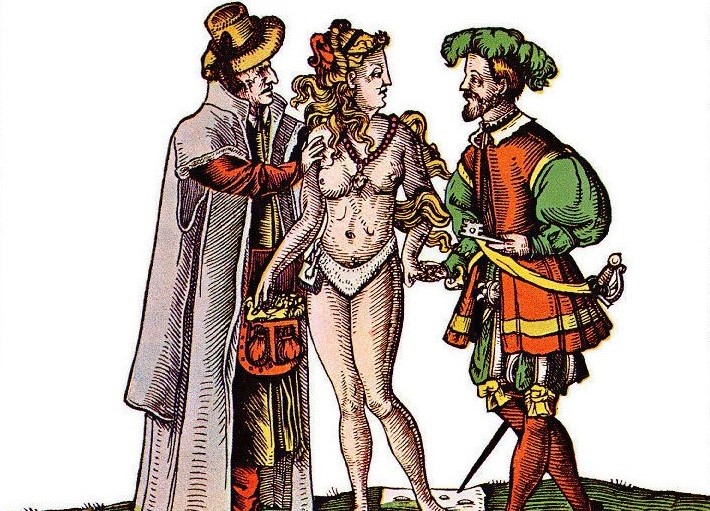
In the 16th century, chastity belts began to appear regularly in drawings. Many of these images were very similar. The husband, often an older gentleman, was going on a trip and was saying goodbye to the wife, who was naked in a chastity belt. Meanwhile, the lover was waiting in the wings with a spare key. One such picture by Heinrich Wirri, drawn about fifty to a hundred years after the end of the Middle Ages (1590), is a clear example.
His picture is a caricature of the futility of such chastity belts. It shows the wife handing over the key to the chastity belt to her husband, who is going on a long trip. An older woman hides behind the bed with another key to her belt (along with her would-be lover). The husband is likened to a fool trying to keep fleas in a basket (bottom right). The cat and the mouse on the floor (bottom left) are a reminder of the saying that when the cat is away, the mice play. The husband also has donkey ears on his hat, which signifies that he is a fool.
Albrecht Classen
Albrecht Classen is a professor at the University of Arizona and one of the leading experts on chastity belts. In 2007 he published The Medieval Chastity Belt: a Myth-Making Process. He says that when he started researching the subject, he quickly realised that there were no records of chastity belts in the Middle Ages.
Classen says that men’s fear is why the concept of the chastity belt has survived for so long. A lover is waiting with an extra key in all images where this theme appears. This idea of metal underwear as an adultery stopper was never taken seriously. Descriptions of women in chastity belts are always humorous.
There are plenty of references to this phenomenon in literature and art, but there are no historical records of a man trying to put his wife in a chastity belt. Any reference to the belts in art is either satire or allegory. The idea of a metal chastity belt was just as funny then as it is now.
People going to museums in Europe may have come across chastity belts in these museums. Examinations of these belts show that they are much younger than declared in the museums, and none of them are from the Middle Ages. Chastity belts on display in prestigious museums have been removed from the exhibition because museums that want to be taken seriously naturally do not want to show fake artefacts.
The famous British Museum in London has one such belt in its possession. According to museum experts, most “medieval” chastity belts in circulation date from the 18th and 19th centuries. They were made as curious artefacts for the lustful or as a joke for the garish. This assertion fits the period because people in the ‘refined’ Victorian era were obsessed with sex and several peculiar misconceptions about it characterised the period.
Practicality and the Situation Today
Apart from the lack of documentation about chastity belts in the Middle Ages, they are illogical. How can a device with holes for urination, defecation, menstruation and hygiene prevent intercourse through the same holes? And locking the woman in this device for years while the man was away would have resulted in many genital infections, sepsis and even death. Not to mention that they would have been made of iron which would cut into the flesh and cause permanent and deep wounds.
Perhaps the idea of chastity belts is so powerful because they are trendy today. Now, they are sold for BDSM and erotic sex, not for restraining women’s sexuality. And the interesting part? They are chiefly manufactured and sold for men. What will historians in five hundred years say about that?


 The Past World
Leave a comment