
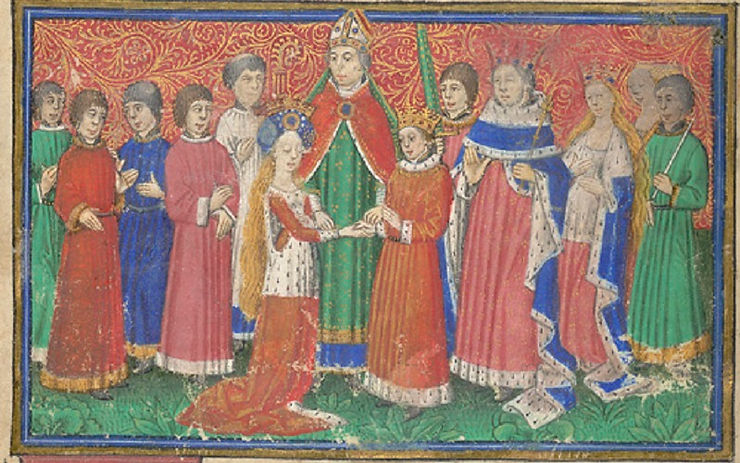
It has long been claimed that law existed in the Middle Ages called jus primae noctis, sometimes also called prima nocta or droit du seigneur in French. According to it, the feudal lord had the right to sleep with his subject’s bride on the wedding night.

Law and Order
But did nobles in the Middle Ages have the right to sleep with the bride on their wedding night? If novels about the Middle Ages, TV shows and movies like the popular but ridiculously historically incorrect Braveheart are anything to go by, these were privileges enjoyed by nobles. But was it like that? Was this provision in the law? The answer to that is no. No law from this time allowed such a thing.
If not law, then perhaps customs? The answer to that is almost certainly no. There are no records of such either. All writings about such traditions appear in later centuries.
But did some morally flexible nobles use their superiority to force the first night? Perhaps they did. But then it was rape by the powerful against the weak. Something that was forbidden by law and condemned. Nobles sometimes got away with things others couldn’t, but no evidence indicates this was practised regularly, let alone was a part of everyday medieval life.
In Ancient Times
The right of a nobleman to the virginity of his subjects appears very early in the writings of antiquity. In the Epic of Gilgamesh, King Gilgamesh of Uruk uses the right to lay with the woman (and the man, too, if he so chooses). It simply says that he is the king and does what he wants. He can take the girl from her mother, her soldier father, or the young bridegroom.
Herodotus also writes about jus primae noctis in his work Historia in the 5th century BC. Herodotus tells about a ruler in Libya who demanded that all virgins who wanted to marry had to meet with him. If he liked them, he would devirginise them before they married.
Herodotus also tells of when the plebeians of the Etruscan city of Volsinii rebelled against the aristocracy in 280 BC. They took the wives of the nobles and placed their daughters under the jus primae noctis.

Middle Ages
These few examples from ancient times say nothing about whether this was standard practice. Everything points in the opposite direction. Herodotus mentions one ruler in particular and points out that he did this; clearly, he finds this strange enough to highlight.
In the Middle Ages, sometimes a so-called “merchet” or marriage fee had to be paid. The prospective bride and groom or their family paid it. Often regulations stated that a subordinate could buy himself out of certain obligations. Many of the feudal lord’s rights were related to the vassal’s marriage, notably his right to choose brides for his subjects. If people wanted to choose their partner, the marriage fee had to be paid. There are even examples of young women working away from home and saving up so they could choose a husband themselves. This payment to the nobleman was compensation for losing valuable labour when the girl married away.
Droit du seigneur or “rights of the noble” was, therefore, nothing more than another tax that had to be paid. In later centuries, this fee was interpreted as a payment to eliminate the nobleman’s right to the first night with the bride. Detailed research on this issue has confirmed that droit du seigneur was always paid in cash and not in kind.

Some have interpreted a similar payment to the Church as a payment related to the “first-night” idea. The truth is that the Church forbade sex between partners on the first night in some areas. Couples had to wait three days in prayer to get into the right divine state of mind before having sex. But it was possible to pay for a concession from the Church to drop this waiting period.
Some argue payment was made with sex, and the clerics had the right to the first night with the bride. But to be honest, paying to lift the sex embargo with sex sounds odd. In addition, this in no way matches the rights of the noble. If the lord had the right to the first night, and so did the priest, one wonders how many first nights were available in the Middle Ages. This argument doesn’t make sense. Yes, the priests had their snouts in everyone’s life, especially if it yielded coins, but coins were all they got.
Later “Sources”
In 1527, the Scottish historian Hector Boece wrote that the “right” had existed in Scotland until Malcolm III (1058–93) abolished it. The king preplaced it with Merchet payments. Boece stated that King Ewen or Evenus III had created a law that said lords had a right to obtain the virginity of all maidens in their land. This, according to Boece, is supposed to have been the tradition for hundreds of years. Other contemporaries of his and later authors adopted this account of his without criticism, and thus the legend spread.

The problem with this “history” is that there never was a King of Scots called Evenus. Boece made him up. In addition, Boece’s account contains many other stories that are just legends. He wrote five hundred years after the tradition was supposed to have been abolished and perhaps a thousand years after the imaginary king imposed the law.
Boece’s story is, therefore, clearly fiction as nothing in other Scottish documents mentions any of this. All later authors who wrote about the rights to the first night based their accounts on this fiction by Boece. Voltaire is undoubtedly the most famous, he wrote a play on this subject in 1762, but it was the first time the term droit du seigneur was used. But Voltaire was not a historian who referred to primary sources. He was a philosopher who wrote a play (which he didn’t even get performed during his lifetime).
One of the most famous examples of the right to the first night is probably Mozart’s The Marriage of Figaro. The opera, which premiered in 1786, tells the story of Count Almaviva’s attempts to seduce the young Susanna and the efforts of the couple, Figaro and Susanna, to stop him. To achieve his goal, the frustrated count threatens to adopt the droit du seigneur. The opera was based on a play of the same title by Pierre Beaumarchais. A fun story and a grand opera, but it hardly counts as a source.
The Legend is a Folklore
If we go by popular stories, folklore, novels, and plays, the “right of the first night” was going on in many parts of Europe for centuries. However, historians’ research into the sources shows no records of this. Nowhere is this mentioned in manuscripts, lawbooks, charters, rulings, trials, commentaries or in books about daily life and marriage customs.
Not a single woman commented on this arrangement, as might be expected if it had been a law or tradition. It’s equally amazing that if this happened for hundreds of years, no husband criticised or even mentioned this. Medieval people loved to draw and paint. We have paintings of people sewing, eating, bathing, working, studying, etc. But no medieval artwork shows anything we can interpret as the right of the first night. The silence is deafening.

Apart from the lack of sources, common sense tells us this would not have been good management. Rape has been, and still is, a weapon of war aimed at humiliating and breaking the conquered. Why treat your citizens in this way in peacetime? This act would create all kinds of trouble for the lord. He would be in constant danger as everyone would hate and despise him (the people hated him enough already). It would be too easy to kill him while he had his trousers, literally, down. But there are no stories about this happening. Powerful nobles in the Middle Ages could get what they wanted by force of arms, oppression and violence. They didn’t need any special laws for that. We must therefore look at the mythical law of jus primae noctis as the imaginings of men from a later age.


Leave a Reply