
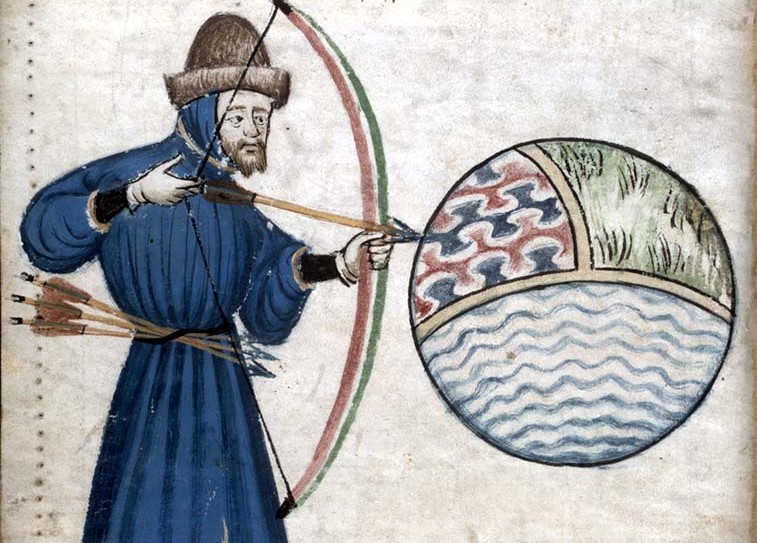
In one word: No. It is a strong belief among us moderns to think that in the Middle Ages, everyone thought the Earth was flat. In school, my teachers taught me this was undoubtedly what the medieval man thought.
But why do we think this, and why is it such a persistent misconception? Is this just confirmation of our tendency to believe we are more intelligent and wiser than people who came before us?
Knowledge in Antiquity and the Middle Ages
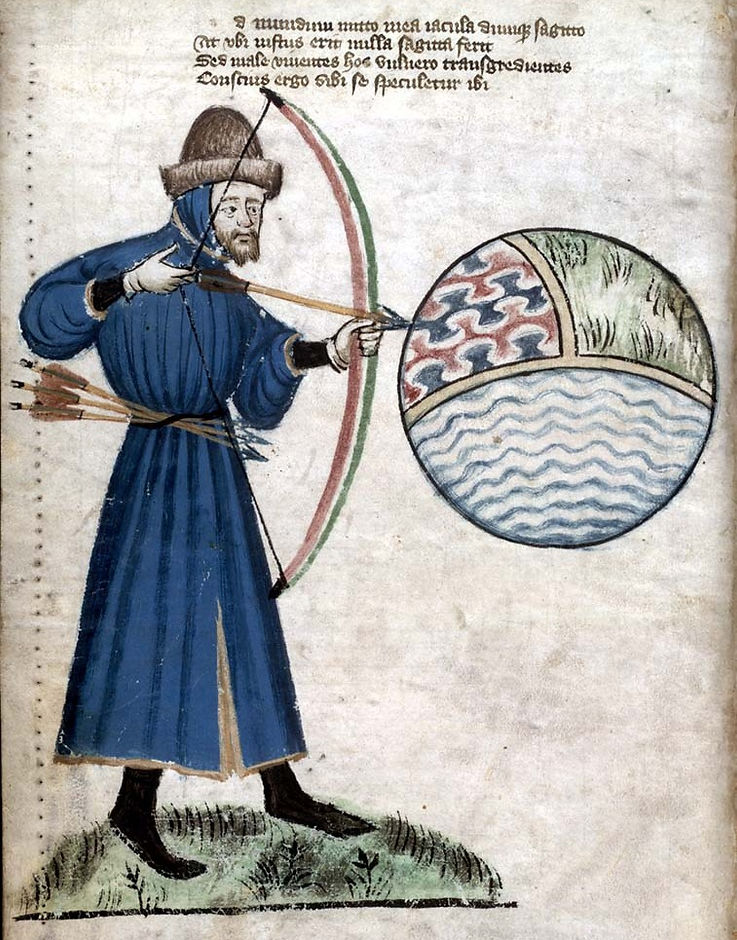
Scholars have considered the Earth round since ancient times, if not longer. All the prominent Greek thinkers from Aristotle (384-322 BC), Eratosthenes (3rd century BC) and Claudius Ptolemy (2nd century BC) based their geographical and astronomical theories on the idea that the Earth was round.
Among the scholars of the Middle Ages who saw the Earth as round, we can mention Augustine of Hippo (354-430), Jeremiah (d. 420) and Ambrosius (d. 420). Bede the Venerable, a monk of the Benedictine Order, writes on similar lines at the beginning of the 7th century.

From the 7th to the 14th century, we can say that all the influential thinkers of the Middle Ages who studied the natural sciences stated plainly that the Earth was a globe. These include Thomas Aquinas (d. 1274), Roger Bacon (d. 1294), Albertus Magnus (d. 1280), Michael Scot (d. 1234), Jean de Sacrobosco (d. 1256), Pierre d’Ailly (d. 1410), Jean Buridan (d. 1358), Nicole Oresme (d. 1382) and Giles of Rome (d. 1316).
For example, the Arab astronomer Ahmad al-Farghani wrote in the 9th century that ships sailing in orbit do not disappear from the horizon as if they had fallen off the Earth but fade slowly from view. This fact was considered proof that the Earth was round.
Prominent poets writing for the public in the vernacular maintained that the Earth was round. Sir John Mandeville wrote in his travelogue published sometime between 1357 and 1371 that the Earth was round and sailors could easily sail around it. Dante Alighieri (d. 1321) says several times in The Divine Comedy that the Earth is a globe. Geoffrey Chaucer (d. 1400) tells the same story in his Canterbury Tales.
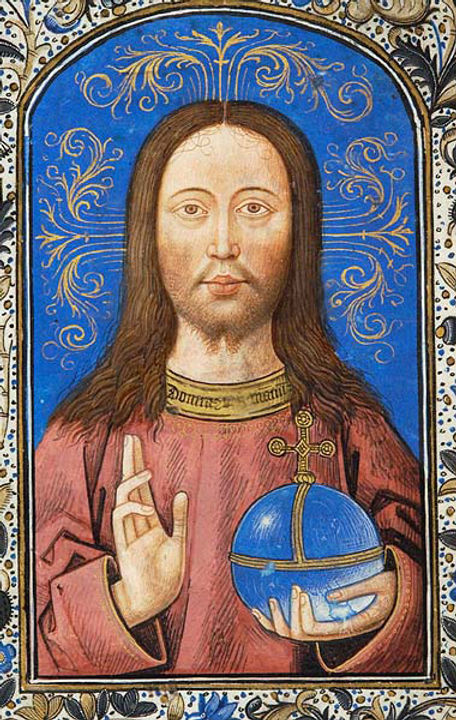
This idea of a round earth is not only expressed in literary works. We can see this in works of art from this time, such as in paintings of rulers. One of the power symbols of kings in the Middle Ages was a gold ball with a cross on top. The sphere represented the Earth, and the cross represented Christ’s dominion over the Earth. The king held the orb because he ruled the Earth (or territory) in the name of Christ.
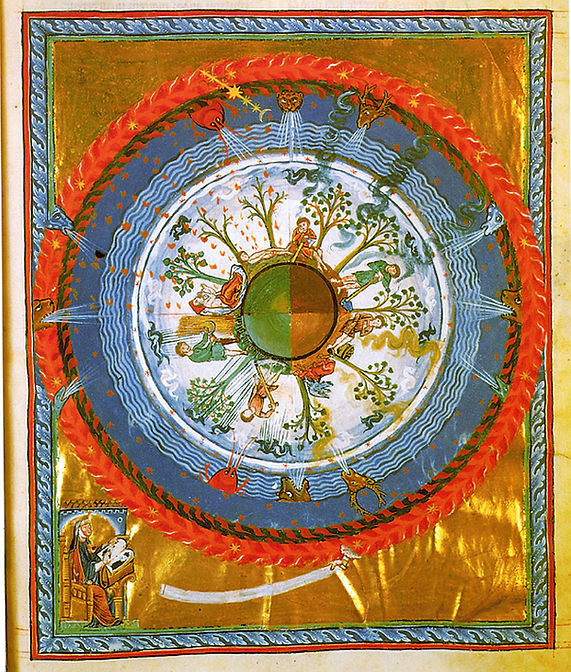
Numerous paintings also exist of Jesus as the world’s saviour (Salvator Mundi). He holds the Earth in one hand in the form of a sphere. The nun, saint and polymath Hildegard von Bingen also drew a picture of the Earth as a circle in the 12th century.
Scholars’ knowledge in the Middle Ages was still extremely limited in various respects. The movement of the celestial bodies that convinced them that the Earth was round also led them to think that they moved around the Earth. The Church was particularly impressed by this doctrine and accepted it as sacred truth. It was logical in their minds that since Jerusalem and the Garden of Eden were both located on Earth, the Earth must be the centre of the universe.
The Church was adamant about this view, and astronomers like Galileo had trouble convincing churchmen otherwise. But no one with any sense claimed that the Earth was in the shape of a giant cake dish. That view of history did not appear until the Modern Age.
The Flat Earth Misconception Emerges
In the 19th century, talking down the past to prove how far humans had travelled on the development path was prevalent. Scholars and writers found fault with everything about the Middle Ages. They convinced themselves that the medieval man had been stupider than those who came before and after. Intellectuals of that century created the theory that inadequate educational system and backward science during the Middle Ages led to a loss of ancient knowledge. Not to be discovered again until the Renaissance.

In the 19th century, there were various ideas about how medieval men thought. One such idea was that rationalists at the time objected to Christopher Columbus’s plans to sail westward to Asia because they feared he would sail off the flat Earth. If we look at the records from this period, it is clear that the objections arose for financial and political reasons on the one hand and logistical reasons on the other. Many thought that Columbus underestimated the size of the Earth. They feared it would not be possible to sail to Asia via the western route without running out of supplies along the way. Sailing that way would not be possible due to the limitations of navigational capacity. Everyone knew that if you sailed westward long enough, you would eventually reach Asia. No one questioned this.
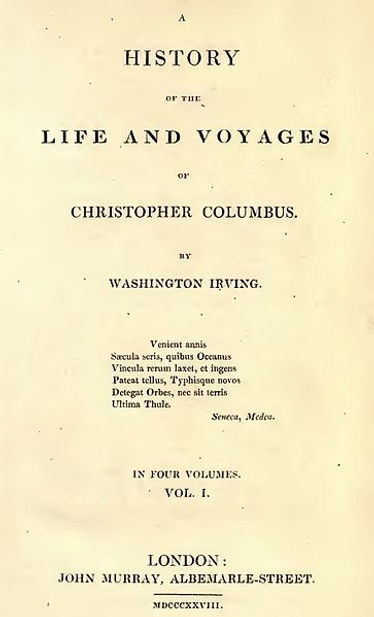
This misconception that people thought the Earth was flat comes primarily from Washington Irving’s book, The Life and Voyages of Christopher Columbus, published in 1828. The person who reads the book thinks he is reading a historical work about the voyage of Columbus. But the book is a novel, and Irving takes the poetic license to relate that Columbus’s contemporaries thought the Earth was flat. Irving’s fanciful idea of the flat Earth gained wings and is still taught in many school books today.
But it is not just this novel alone that contributes to this misconception. As stated before, we are very willing to believe that modern man is superior to medieval man. We are now far ahead in technology and science. It is, therefore, easy for us to look down on the Middle Ages as the dark ages of ignorance. We allow ourselves to forget that modern technology is part of gradual evolution over the centuries.
If we would suddenly throw the 21st-century man back to the year 1200, what could he accomplish on his own? The average person uses the internet but has no idea how it works. We would soon find out that the people of that time were not dumber than us. With the same tools as the medieval man, we would not accomplish much more than him, let alone invent cell phones or the internet. All generations build on the knowledge of previous generations. It does not mean that the previous generation was stupid. The world view, devices and tools, knowledge and values were different. That’s all.
And despite all the photographs of planet Earth and our advanced measurement techniques, many people still claim that the Earth is flat. What excuse do these people have?


 The Past World
Leave a comment